
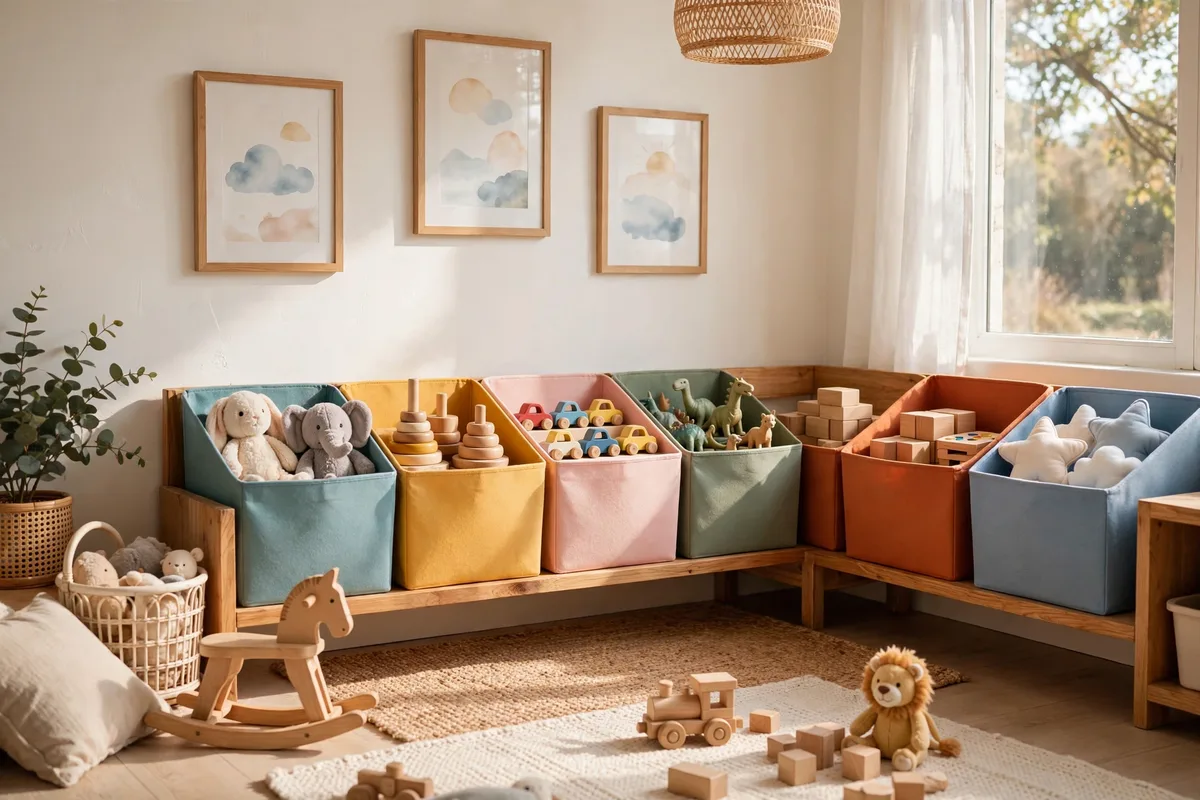
Most toy organization advice stops at “buy more bins.” But the real problem isn’t storage — it’s that toys of wildly different ages and purposes are all mixed together, which makes cleanup impossible for kids and playtime less fun. The fix is a two-way sort: by age (so the right child can reach and safely use the right toys) and by use (so cleanup is one quick decision, not a treasure hunt). Here’s how to build that system in a weekend.
Step 1: Purge Before You Organize
Organizing toys you don’t need is just rearranging clutter. Start with the four-box method:
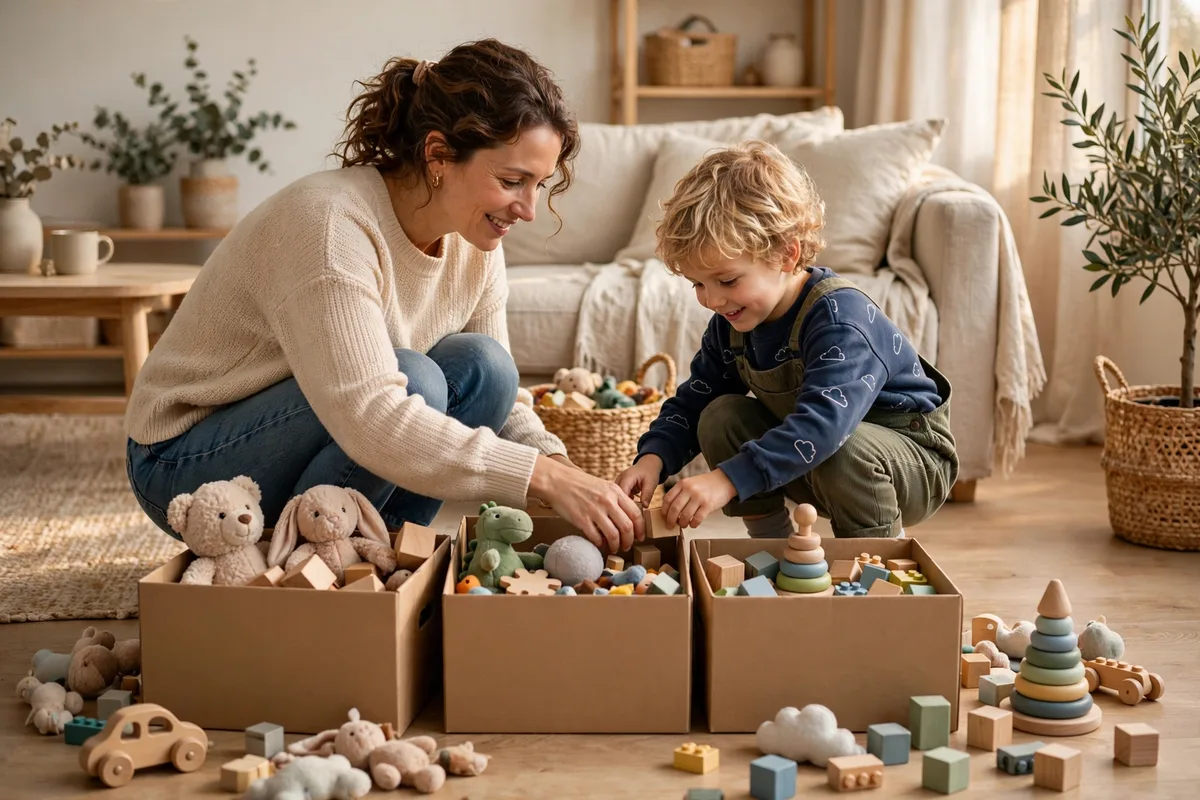
- Gather every toy in the house into one room. The visual shock is motivating.
- Sort into four piles:
- Keep — played with in the last month, or genuinely loved
- Rotate — good toys that aren’t current favorites (more on this in Step 5)
- Donate — outgrown or ignored for months, in good condition
- Discard — broken, missing essential pieces, or unsafe
Ask kids age 4+ one question: “Do you play with this?” — not “Do you want to keep it?” The first prompts honest answers; the second triggers hoarding instincts. For younger kids’ toys, you can purge while they nap and involve them in organizing later.
For the rest of the house, our guide to decluttering your home uses the same keep-donate-discard logic room by room.
Safety first: Toss anything with small detachable parts for children under 3 (choking hazard), toys with broken sharp edges, and anything recalled — you can check recalls on the U.S. Consumer Product Safety Commission site. Wall-anchor all shelving, even low units, since toddlers climb.
Step 2: Sort by Age — Safety and Access First
Age is your first filter because it determines where toys live and who can reach them:
| Age band | Typical toys | Storage rule |
|---|---|---|
| 0–2 | Soft toys, rattles, stacking toys, board books | Low open baskets on the floor, no lids or latches; small parts kept entirely out of reach |
| 3–5 | Blocks, play figures, art supplies, simple puzzles | Low shelves at child height; picture labels on bins (pre-readers match images); art supplies on a higher shelf for supervised use |
| 6–9 | LEGO/building sets, board games, craft kits | Bins with lids and compartments; can manage more categories; old-enough for under-bed storage |
| 10+ | Complex kits, electronics, hobby gear | Their room, their system — agree on a weekly tidy standard rather than dictating the layout |
The key insight: toys for younger kids must be reachable by them but not contain hazards; toys for older kids (small LEGO pieces, craft tools) must be reachable only by them. In mixed-age homes, keep older kids’ small-part toys on higher shelves the toddler can’t reach.
Step 3: Sort by Use — The Five Zones
Within each age area, group toys by how they’re actually used. Five categories cover nearly everything:
- Active play — balls, ride-ons, building toys, anything loud or physical
- Creative — art supplies, craft kits, building sets, musical toys
- Quiet play — books, puzzles, coloring, comfort toys
- Outdoor — sand toys, bikes, sports gear, water toys (store near the door or in the garage)
- Keepsakes & seasonal — sentimental toys, holiday-specific items, outgrown favorites you’re saving
Assign each category a home base. Active play lives where there’s room to move; quiet play lives in bedrooms; outdoor gear lives by the exit. When a toy’s home matches its use, cleanup becomes obvious: “creative things go back to the creative bin.”
Step 4: Set Up Storage Kids Can Actually Use
Match the storage to the child’s ability, not your Pinterest board:
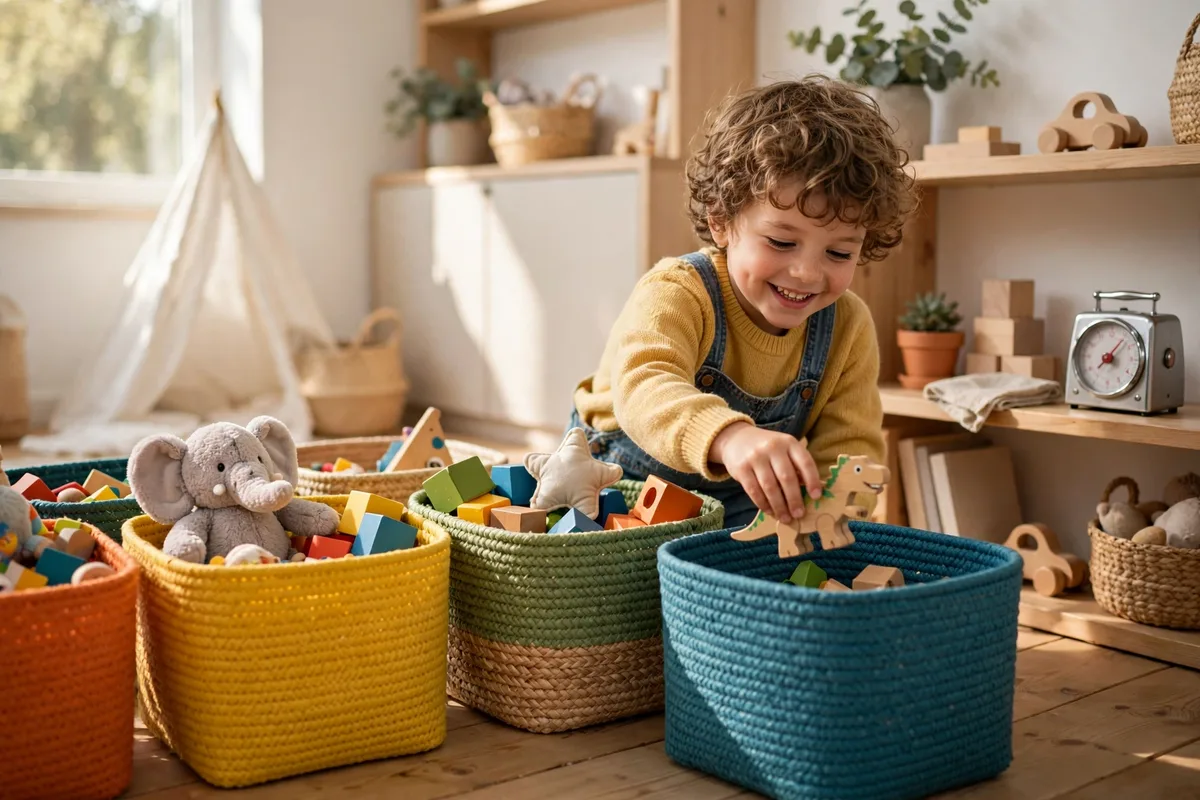
- Under 3: One big basket per type, no lids. They dump and explore — your job is just to give the dump a destination.
- Ages 3–5: Bins with picture labels at 60–90 cm height. Cleanup becomes a matching game: photo of blocks on the blocks bin. Limit to 5–7 categories.
- Ages 6+: They can handle lidded bins, compartments, and labeled boxes. Let them design their own shelf layout — ownership means maintenance.
General rules that work at every age: clear or labeled containers (kids can’t put away what they can’t identify), one category per bin, and low shelves for daily toys with backup/rotation stock stored higher or elsewhere. For a similar system applied to chores, see age-appropriate household tasks.
Step 5: Start a Toy Rotation
Too many toys out at once means shallow play and marathon cleanups. A rotation keeps play fresh with fewer toys in circulation:
- Keep 10–20 toys accessible per child (fewer for toddlers, more for older kids); store the rest in labeled bins by category.
- Rotate every 2–4 weeks — swap out a few bins for stored ones.
- Let kids age 4+ help choose what comes out and what goes away; it teaches decision-making and cuts resistance.
- Stored toys that aren’t requested for three months are donation candidates.
Parents who try this consistently report the same thing: kids play longer and deeper with each toy, and cleanup drops from 30 minutes to 10.
Step 6: Build the Cleanup Routine
A system only works if it’s maintained. Keep it tiny and daily:
- The 10-minute tidy: Set a timer each evening and everyone tidies together. Even toddlers can toss soft toys into a basket.
- One in, one out: When a new toy arrives (birthdays, holidays), an old one leaves — donate it together.
- Quarterly purge: Before birthdays and holidays, repeat the four-box sort.
Work the tidy into your existing rhythms — right after dinner or as part of your family morning routine wind-down — so it becomes habit, not negotiation.
Step 7: Store by Location, Not Just by Room
Think about where play happens:
- Living room: Active play toys in hidden storage (ottomans, closed baskets) so the room stays adult-friendly. Keep only the current rotation here.
- Bedrooms: Quiet-play toys, books, and comfort items that support independent time.
- Near the door/garage: Outdoor gear, ready to grab.
- Closet or garage: Rotation stock, seasonal toys, and keepsakes in labeled bins.
This division means no single room ever holds the whole collection — and no cleanup ever faces the whole collection.
Frequently Asked Questions
How many toys should a child have?
There’s no magic number, but most families find 10–20 accessible toys per child (in rotation) is the sweet spot — enough variety, shallow enough for real cleanup. The total collection can be larger; it just shouldn’t all be out at once.
What if my kids share a room but are different ages?
Use the age rule for safety: older kids’ small-part toys live on higher shelves the younger child can’t reach. Give each child one personal bin or shelf that’s theirs alone, even in a shared room.
How do I handle the sentimental toys I can’t part with?
Keep a single keepsake box per child. When it’s full, something goes before something new comes in. Sentimental value is real — it just needs a boundary.
My child dumps every bin the moment I organize. What now?
Fewer bins, fewer toys out, and bins without lids for young dumpers. The 10-minute daily tidy matters more than any storage product.
The Bottom Line
Sort by age for safety and access, sort by use for sanity, rotate to keep things fresh, and tidy ten minutes a day. You don’t need a perfect system — you need one your kids can actually follow. Start with the four-box purge this weekend, and the bins will finally start working.
For more ideas on room-by-room organization systems, the LoadUp playroom decluttering guide has practical storage and rotation tips worth browsing.