
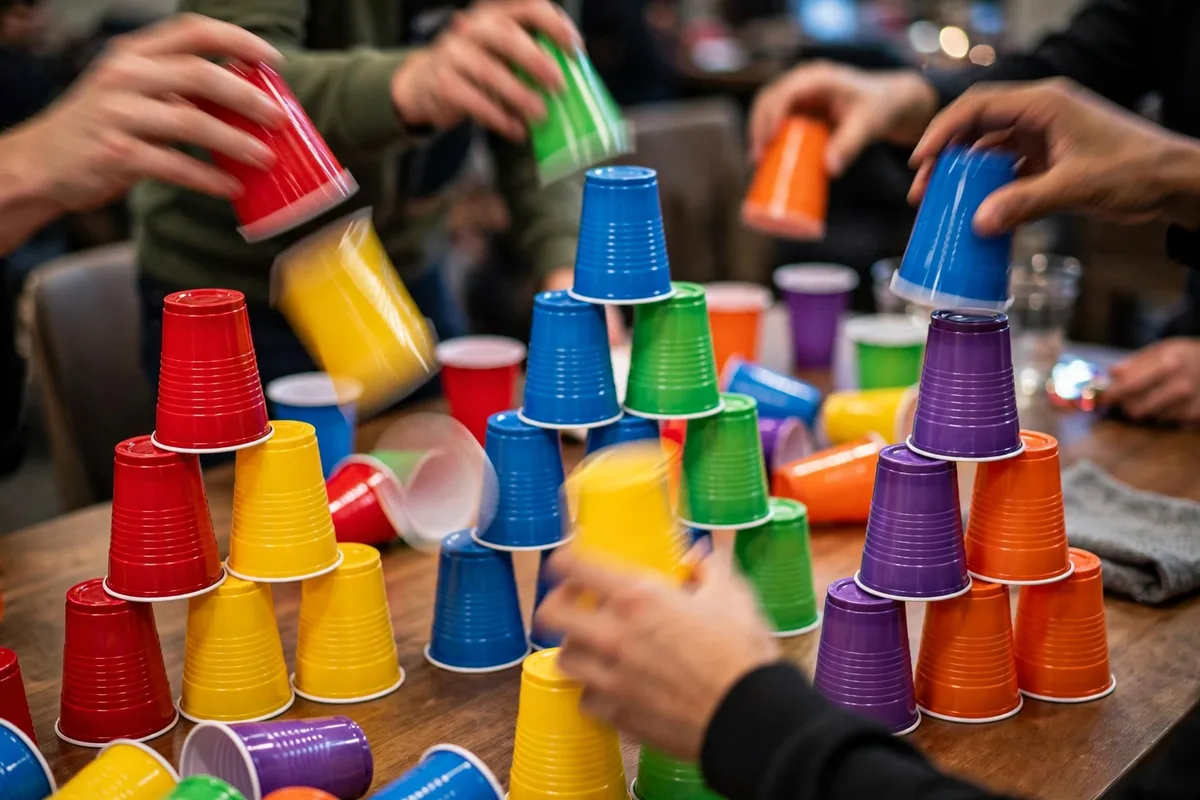
It looks like a party trick: someone stacking and unstacking plastic cups at impossible speed, hands blurring, timer beeping. But sport stacking — better known as cup stacking or speed stacking — is a real competitive sport with a world governing body, standardized equipment, official rule books, and world championships. It’s also one of the cheapest, most accessible sports you can start at home today.
This guide covers what sport stacking is, the official sequences and rules, the equipment you need, how to learn the basic patterns, and how to take it from living-room fun to actual competition.
What Is Sport Stacking?
Sport stacking is a timed individual and team sport in which athletes stack specially designed plastic cups in predetermined sequences — up into pyramids, then back down — as fast as possible. The World Sport Stacking Association (WSSA) governs the sport worldwide, standardizes the rules, and certifies official tournaments and records.
The sport’s origin story starts in the early 1980s, when Wayne Godinet introduced cup stacking to kids at a Boys & Girls Club in California. It spread through schools, got a famous boost from a 1990 appearance on late-night TV, and formalized over the following decades. PE teacher Bob Fox helped create the WSSA, which turned a playground activity into an organized sport with age divisions, world championships, and timed events measured to the thousandth of a second.
Today it’s especially popular in schools and youth programs, but adult divisions exist too — and the world records are genuinely astonishing displays of hand speed and coordination.
The Equipment: Not Just Any Cups
You can’t compete with party cups. Official sport stacking equipment is engineered for speed:
- Stacking cups: Lightweight plastic cups with interior ribs that keep nested cups from sticking, a slightly textured exterior for grip, and ventilation holes in the top to release air pressure so cups separate instantly. They come in sets of 12.
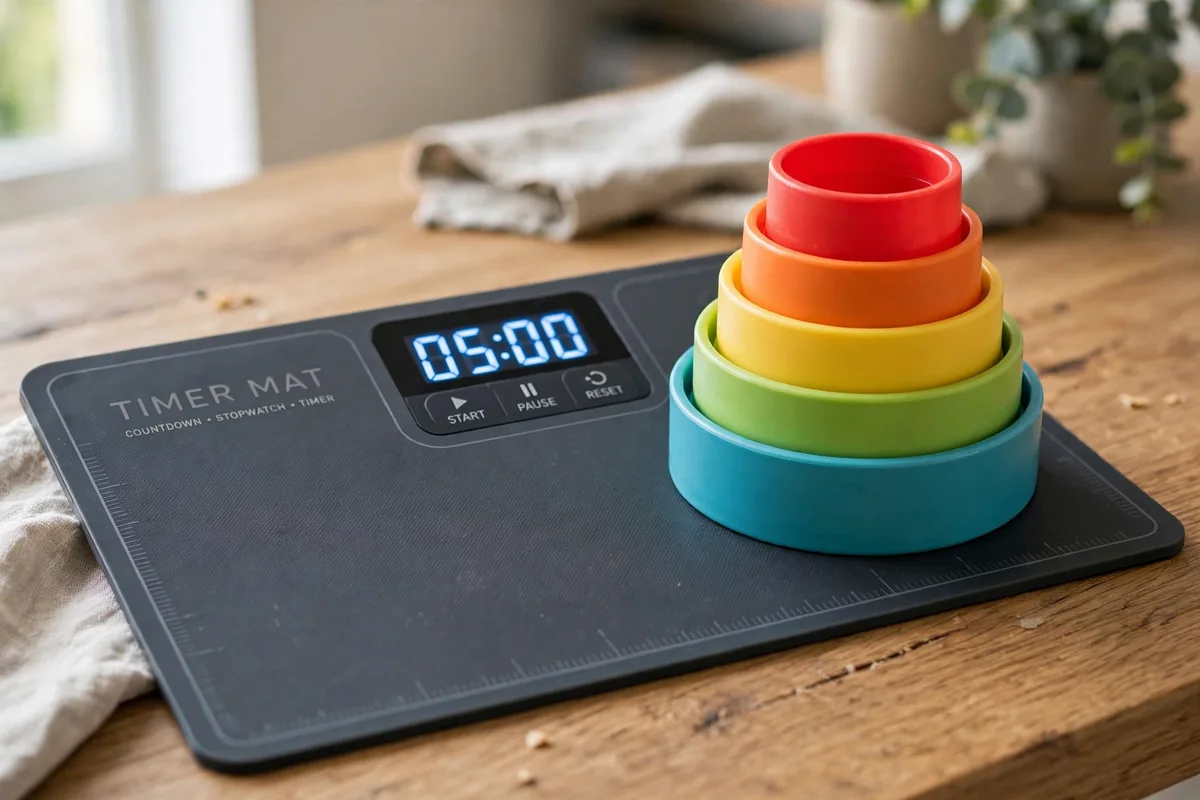
- StackMat: A non-slip mat with an attached digital timer. You start the timer with both hands, stack, then stop it the same way — your time is your score.
- Training cups: Weighted metal “Super Stacks” used in warm-ups so regular cups feel lighter by comparison. Oversized “Jumbo Stacks” are used mainly in PE classes.
A starter set with 12 cups and a mat is inexpensive compared to almost any other sport’s gear, which is a big part of why schools adopted it so widely.
The Three Official Sequences
WSSA individual competition tests three sequences, performed in order: 3-3-3, 3-6-3, and the Cycle.
1. The 3-3-3 (9 cups)
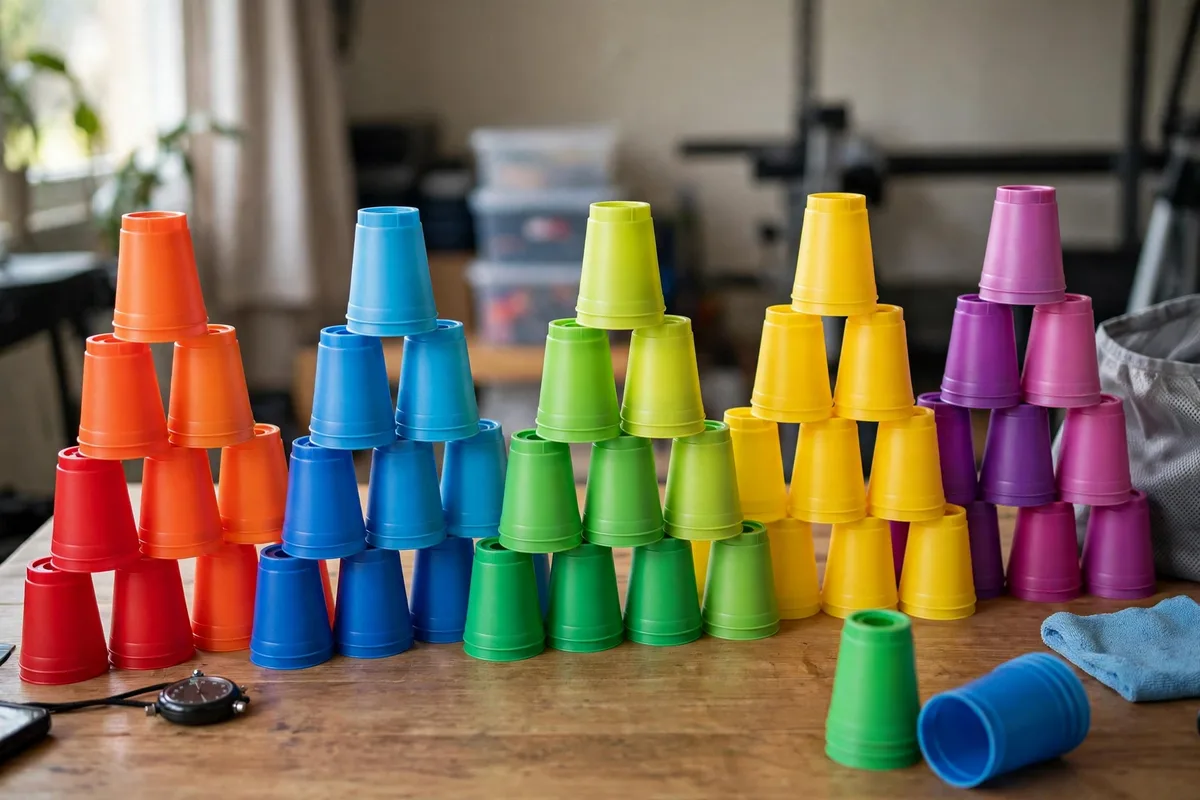
Three separate stacks of three cups each. You up-stack each set of three into a small pyramid (left to right or right to left — your choice), then down-stack them back into nested columns in the same order. This is where beginners start: it teaches the fundamental rhythm of grabbing, placing, and collapsing cups.
2. The 3-6-3 (12 cups)
Three stacks: three cups, six cups, three cups. The middle six-stack builds a bigger pyramid (3-2-1), which introduces the two-handed techniques and transitions that define the sport. Most stackers find this is where real speed starts to matter.
3. The Cycle (12 cups)
The marquee event. It chains everything together: a 3-6-3, down-stacked; then a 6-6 (two six-stacks); down-stacked; then a 1-10-1 (a single cup, a ten-cup pyramid, a single cup); then everything down-stacked back to the starting position. The Cycle is the sequence you see in world-record videos, and it demands memorized choreography performed at sprint pace.
The Core Rules
The WSSA rule book is detailed, but the fundamentals are straightforward:
- Direction consistency: Up-stack and down-stack in the same direction (all left-to-right or all right-to-left). No switching mid-sequence.
- One stack at a time (mostly): During up-stacking, you can’t work two stacks simultaneously — both hands focus on one stack. Down-stacking allows two stacks at once, with specific rules about when each hand can start.
- Fumbles: A tipped or dropped cup must be fixed — the sequence has to be completed correctly for the time to count. There’s no “close enough” in competition.
- Timer procedure: Both hands start the timer, both hands stop it. Touching the timer mid-run is a violation.
- Divisions: Competitors compete in age (and sometimes gender) divisions based on their age on tournament day.
- Warm-ups: In official prelims, each stacker gets up to two warm-up attempts before each of the three timed sequences.
In casual play, nobody cares about most of this — but knowing the real rules makes practice more productive and tournament day less surprising.
How to Learn: A Beginner’s Progression
Step 1: Get the feel (day 1)
Forget speed. Set up a 3-3-3 and practice the basic motion: sliding cups off the nested stack, placing them into pyramids, and collapsing them back. Your hands need to learn where the cups are without your eyes micromanaging. Expect fumbles — everyone fumbles.
Step 2: Learn the 3-3-3 cold (week 1)
Drill the 3-3-3 until you can do it without thinking about the pattern. Focus on smooth, quiet hands — slapping cups around feels fast but wastes motion. Time yourself casually to track progress, but don’t chase records yet.
Step 3: Add the 3-6-3 (weeks 2-3)
The six-stack pyramid is the first real technique jump. Learn the standard hand placements for building 3-2-1 pyramids efficiently — this is where watching tutorial videos of experienced stackers pays off enormously, since the efficient motions aren’t intuitive.
Step 4: Build the Cycle (month 2+)
Learn the Cycle in chunks: master the 3-6-3 portion, then the 6-6, then the 1-10-1, then chain them. The transitions between phases are where time is won or lost.
Step 5: Train like an athlete
Once the patterns are memorized, training shifts to consistency and speed: timed runs, filming yourself to spot wasted motion, practicing under pressure (friends watching, tournament simulation), and drilling your weakest transitions specifically.
Why Schools and Coaches Love It
Sport stacking’s advocates point to real benefits, and some have research behind them. A university study published in the journal Perceptual and Motor Skills found that stacking practice improved hand-eye coordination and reaction time. Coaches like that it’s ambidextrous by design — both hands work equally — and that it develops bilateral coordination, focus, and sequencing skills.
It’s also radically inclusive: it needs minimal space and equipment, works for a huge range of ages and abilities, and doesn’t favor any body type. Kids who don’t thrive in traditional team sports often find their competitive home in stacking.
Competing: From Local Tournaments to Worlds
The WSSA sanctions tournaments at local, regional, national, and world levels. Local school and community tournaments are the entry point — low pressure, cheap or free, and full of beginners. From there, stackers can qualify upward through the competitive pyramid to national championships and the World Sport Stacking Championships.
Beyond individual timed events, competitions include head-to-head races and relay events where teams stack in sequence. The relay is a crowd favorite: the energy of four stackers handing off under time pressure is electric.
If there’s no tournament near you, the global stacking community is very active online — stackers share videos, technique breakdowns, and training tips, and virtual competitions exist for remote participation.
Tips for Getting Faster
- Film yourself. Wasted motion is invisible in real time but obvious on video.
- Slow is smooth, smooth is fast. Drill new patterns slowly until the motion is clean, then add speed. Rushing a sloppy pattern just engraves bad habits.
- Protect your cups. Warped or sticky cups kill times. Store them nested properly, keep them clean, and replace worn sets.
- Practice transitions, not just stacks. The moments between pyramids are where races are decided.
- Warm up your hands. Finger stretches and a few easy runs before timed attempts — treat it like the athletic event it is.
- Compete early and often. Tournament pressure is its own skill. The sooner you practice performing while nervous, the faster that nervousness stops costing you seconds.
Frequently Asked Questions
Is cup stacking really a sport?
Yes. It has a world governing body (the WSSA), standardized equipment and rules, age divisions, sanctioned tournaments, and world championships. The name officially changed from “cup stacking” to “sport stacking” specifically to reflect its recognition as a sport.
How old do you have to be to compete?
There’s no minimum in principle — divisions start very young, and the sport is huge in elementary schools. Adult and senior divisions exist too.
How much does it cost to start?
A basic set of 12 official cups is affordable, and a StackMat with timer costs more but is optional for beginners. Compared to nearly any other sport, the startup cost is minimal.
What’s the world record for the Cycle?
Records fall regularly as technique evolves — check the WSSA’s official records for the current marks. The top times are well under six seconds, which you have to see to believe.
Does sport stacking really improve coordination?
A published university study found improvements in hand-eye coordination and reaction time from stacking practice. It’s widely used in PE programs partly for these developmental benefits.
Can you stack with regular plastic cups?
For fun, sure. For real practice, no — regular cups stick together, lack grip texture, and have no ventilation, making them frustratingly slow. Proper cups are worth it.
Looking for more ways to liven up a gathering? Our guess the lyrics game ideas and scavenger hunt ideas are perfect companion activities for parties and family nights.