
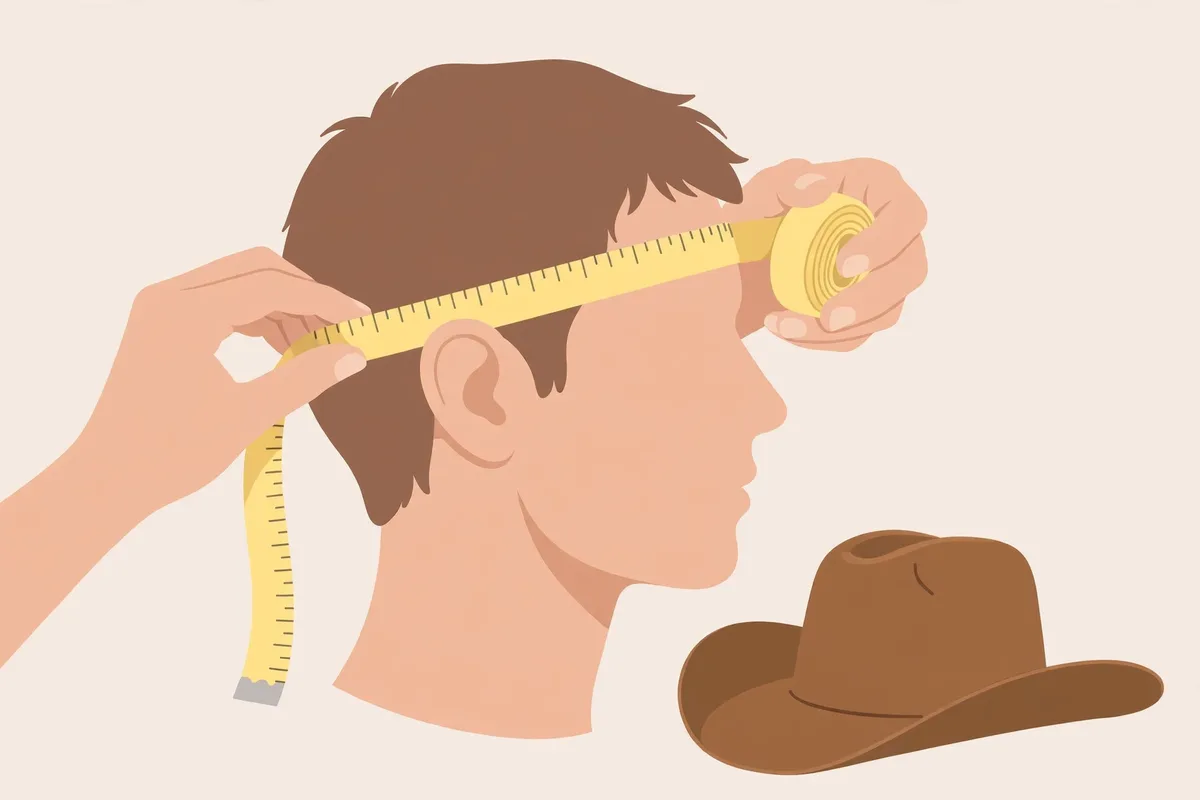
The short answer: measure around your head about a finger’s width above your eyebrows and ears, then match the inches to a hat size — most adults land between 7 and 7 3/8, with each 1/8 size step equal to about 3/8 of an inch of head circumference. If you fall between sizes, size up; a slightly loose hat can be padded, but a tight one can’t be fixed. Below is the full chart plus how to measure, how a hat should fit, and how to fix common fit problems.
How to Measure Your Head for a Cowboy Hat
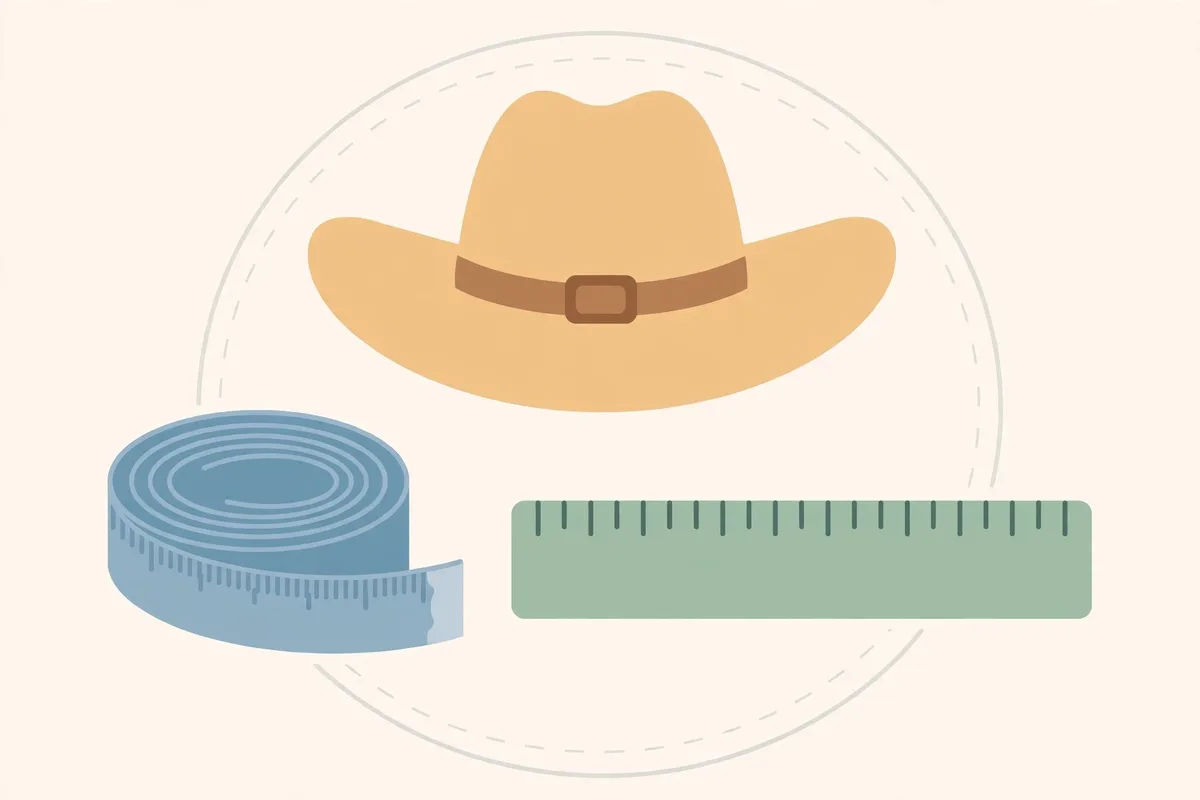
You need a soft tape measure — or a piece of string and a ruler. A friend helps, but you can do it solo in front of a mirror.
- Position the tape where the hat will sit. Wrap it around your head about a finger’s width (roughly 1/2 inch) above your eyebrows and just above the tops of your ears, crossing the widest part of the back of your head. Keep it level — dipping or tilting throws off the reading.
- Keep it snug, not tight. The tape should feel like a comfortable hat band — touching all the way around without pressing into your skin. Don’t pull it tight; a too-tight measurement gives you a too-small hat.
- Measure twice. Take the measurement two or three times and use the largest reading. Heads aren’t perfectly round, and a slightly larger number errs on the comfortable side.
- Note inches and centimeters. US hat sizes are based on inches of head circumference, so inches are what you need. Centimeters help if you’re comparing international charts.
If you’re using string, mark where it overlaps, then lay it flat against a ruler. Non-stretchy string works best — yarn and elastic cords lie.
The Cowboy Hat Size Chart
US hat sizes run in 1/8 increments from about 6 3/4 up to 7 3/4 and beyond. The hat size number is roughly your head circumference in inches divided by pi — so a 22-inch head is about a size 7. Here’s the standard conversion:
| US Hat Size | Head Circumference (inches) | Head Circumference (cm) | Letter Size |
|---|---|---|---|
| 6 5/8 | 20 7/8 | 53 | XS |
| 6 3/4 | 21 1/4 | 54 | S |
| 6 7/8 | 21 5/8 | 55 | S |
| 7 | 22 | 56 | M |
| 7 1/8 | 22 3/8 | 57 | M |
| 7 1/4 | 22 3/4 | 58 | L |
| 7 1/8–7 1/4 range | 22 3/8–22 3/4 | 57–58 | M/L |
| 7 3/8 | 23 1/8 | 59 | L |
| 7 1/2 | 23 1/2 | 60 | XL |
| 7 5/8 | 23 7/8 | 61 | XL |
| 7 3/4 | 24 1/4 | 62 | XXL |
A few things to know about this chart. First, letter sizes (S, M, L, XL) each cover two number sizes, so they’re less precise — fine for casual straw hats, less ideal for a fitted felt hat you want to wear all day. Second, sizing varies slightly between makers; a 7 1/4 from one brand may fit a touch differently than another’s. When buying from a specific maker, check their own chart — the one above is the industry standard most follow. Third, sizes above 7 3/4 (7 7/8, 8) exist for larger heads; specialty western stores stock them even when general retailers don’t.
Between sizes? Always go up. Hat sizing inserts, foam reducer strips, and adjustable sweatbands can take up slack in a slightly large hat. Nothing comfortably fixes a hat that’s too small — it will give you a headache and ride up.
How a Cowboy Hat Should Fit
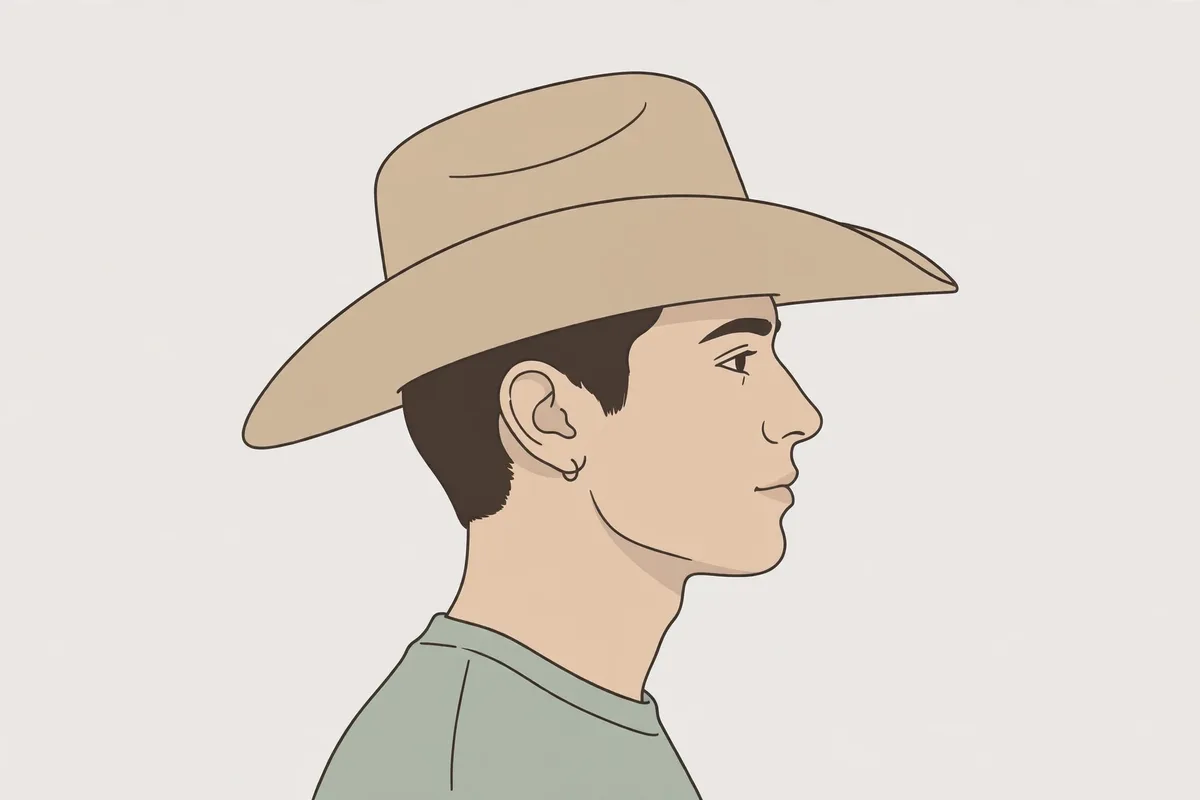
A proper fit is snug enough to stay on in a breeze and comfortable enough to forget you’re wearing it. Here’s the checklist:
Even contact all the way around. You should feel the sweatband touching your head evenly — no gaps at the sides, no pressure digging into your forehead.
Sits level, about two fingers above the eyebrows. The front brim should sit roughly two finger-widths above your eyebrows. If it slides down toward your eyes, it’s too big.
Stays put when you nod. Tip your head forward and shake gently. The hat should stay in place without you holding it. If it lifts off in a light wind, it’s too loose.
No red line or headache. After wearing it for an hour, there should be no red pressure line across your forehead and no headache. Either one means too tight — or the wrong oval shape (see below).
Snug against the neck at the back. The back of the hat should rest close to your neck without riding up when you move.
Oval Shape: The Fit Detail Most People Miss
Two heads can measure exactly the same and need different hats, because heads come in different oval shapes. Most people have a regular oval (slightly longer front-to-back than side-to-side) or a long oval (noticeably longer front-to-back). Some hat makers offer long-oval versions of their hats.
The telltale sign of an oval mismatch: the hat presses on your forehead and the back of your head but feels loose or rocks side to side. That’s not a size problem — it’s a shape problem, and sizing up or down won’t fix it. If you feel that pattern, look for long-oval options or have a hat shop stretch the hat front-to-back (most western hat shops offer stretching).
Felt vs. Straw: Sizing Differences
Felt hats (wool or fur felt) are worn fall through spring. They fit more precisely and break in slightly — the sweatband molds to your head over the first weeks, so a felt hat that’s snug-but-comfortable on day one usually becomes perfect. Don’t buy a felt hat that’s already loose.
Straw hats are summer hats. They don’t conform to your head the way felt does, and many come in S/M/L/XL rather than numbered sizes. Straw also doesn’t stretch, so fit matters more at purchase. If you’re between letter sizes in straw, size up and use the sizing tape most straw hats include.
One more difference: felt hats shrink slightly if they get soaked and dry improperly. If your felt hat gets rained on, let it dry upside down on its crown (not on the brim) at room temperature — never with heat.
Fixing a Hat That Doesn’t Quite Fit
Slightly too big: Foam sizing inserts or adhesive sizing tape stuck inside the sweatband take up the slack. Place them at the front and back (not the sides) to preserve the oval shape. Most hat shops sell reducer strips cheaply, and many hats ship with them.
Slightly too small: A hat shop can stretch it — usually up to about a quarter size — using a hat stretcher or steam. This works far better on felt than straw. Don’t try to force-stretch a straw hat; it cracks.
Pressing on the forehead only: Likely an oval mismatch. Try a long oval, or have the shop stretch it front-to-back.
Sweatband issues: If the hat fits but the sweatband irritates your skin, a hat shop can replace the sweatband. Leather sweatbands break in and get more comfortable; synthetic ones sometimes don’t.
Caring for the Fit Long-Term
Store felt hats upside down on the crown or on a hat rack — never flat on the brim, which warps it over time. Keep hats away from direct heat (car dashboards in summer are notorious hat-shrinkers). Brush felt hats with a soft brush to remove dust, always brushing counterclockwise. For straw, a damp cloth handles most dirt. A hat that fit perfectly and suddenly feels tight may have shrunk from heat or moisture — a hat shop can usually restore it.
Frequently Asked Questions
What is the average cowboy hat size for men?
Most adult men wear between 7 and 7 3/8. The single most common size is 7 1/4.
What is the average cowboy hat size for women?
Most adult women wear between 6 7/8 and 7 1/4, with 7 being very common. Women’s western hats use the same numbered sizing as men’s.
Do cowboy hats stretch over time?
Felt hats conform to your head as the sweatband breaks in, effectively gaining a touch of room. They don’t truly stretch larger on their own — a hat shop can stretch felt deliberately.
Should a cowboy hat be tight or loose?
Snug. It should grip gently all the way around without pressure points. A hat you can spin freely on your head is too loose; one that gives you a headache is too tight.
How do I know if I need a long oval?
If the correct size presses your forehead and the back of your head while feeling loose at the sides, you likely need a long oval. Roughly a third of people fit long ovals better than regular.
Can kids wear the same size chart?
The chart works the same way — measure the head and match the size — but children’s heads are smaller, so they’ll land at the low end. Many kids’ hats come in S/M/L groupings rather than numbered sizes.
Getting the size right is the whole game with cowboy hats — the style, brim, and crease are personal taste, but fit is physics. Measure carefully, use the chart, size up when between, and don’t ignore the oval. If you’re building a full western look, our head shapes guide can help you match brim and crown styles to your face, and our body shapes guide covers balancing proportions for any outfit.