
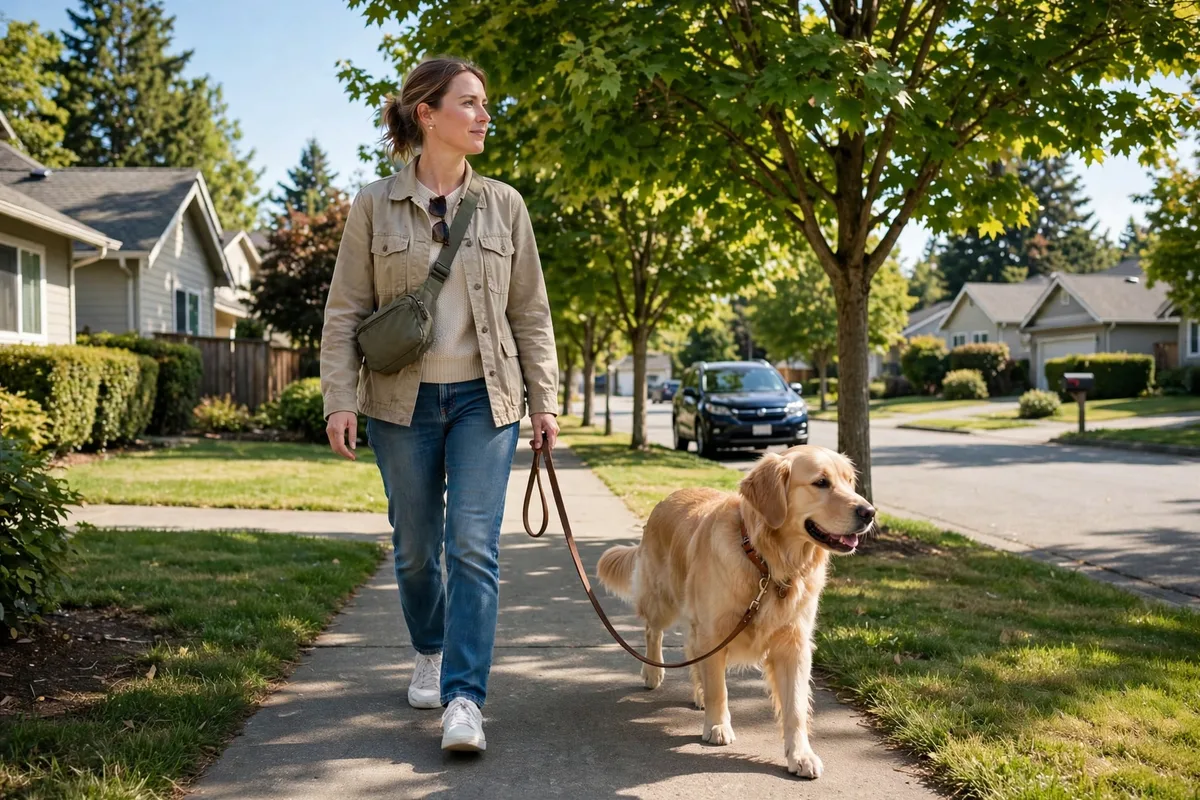
A dog that walks nicely on a leash is a dog you actually want to take places. No sore shoulder, no sprinting after squirrels, no apologizing to neighbors. Good leash manners aren’t about a perfect heel — they’re about a loose leash, a dog that checks in with you, and walks you both enjoy.
This guide covers the foundation: the right gear, how to introduce it without stress, and a step-by-step method for teaching your dog that a loose leash makes good things happen. Most dogs show real improvement within two to three weeks of short daily practice.
Why Leash Manners Matter More Than You Think
Pulling isn’t just annoying — it’s self-rewarding. Every time your dog pulls and reaches the interesting smell, pulling paid off, and dogs repeat what works. Your job is to make the opposite pay better: a loose leash is what unlocks forward motion.
Good leash manners also make everything else easier. A dog that walks calmly is easier to exercise, and a well-exercised dog is calmer at home — which is the whole point of building a daily dog walking routine.
Get the Gear Right First
The wrong equipment makes training harder and can hurt your dog.
- A 4- to 6-foot flat leash. Not retractable. Retractable leashes teach pulling by design — the dog learns that straining forward pays off with more line.
- A well-fitting harness or flat collar. For most dogs, a front-clip harness is the best starter tool: it reduces the mechanical advantage of pulling without pain. Avoid choke chains, prong collars, and shock collars — they suppress pulling through pain, which can create fear and reactivity problems far harder to fix than pulling.
- Treats your dog actually cares about. Walks are full of competition: squirrels, smells, other dogs. Use small, soft, high-value treats — the good stuff from the fridge.
- A treat pouch. Fumbling in a pocket for treats while your dog drags you down the sidewalk doesn’t work.
Step 1: Make the Gear Mean Good Things
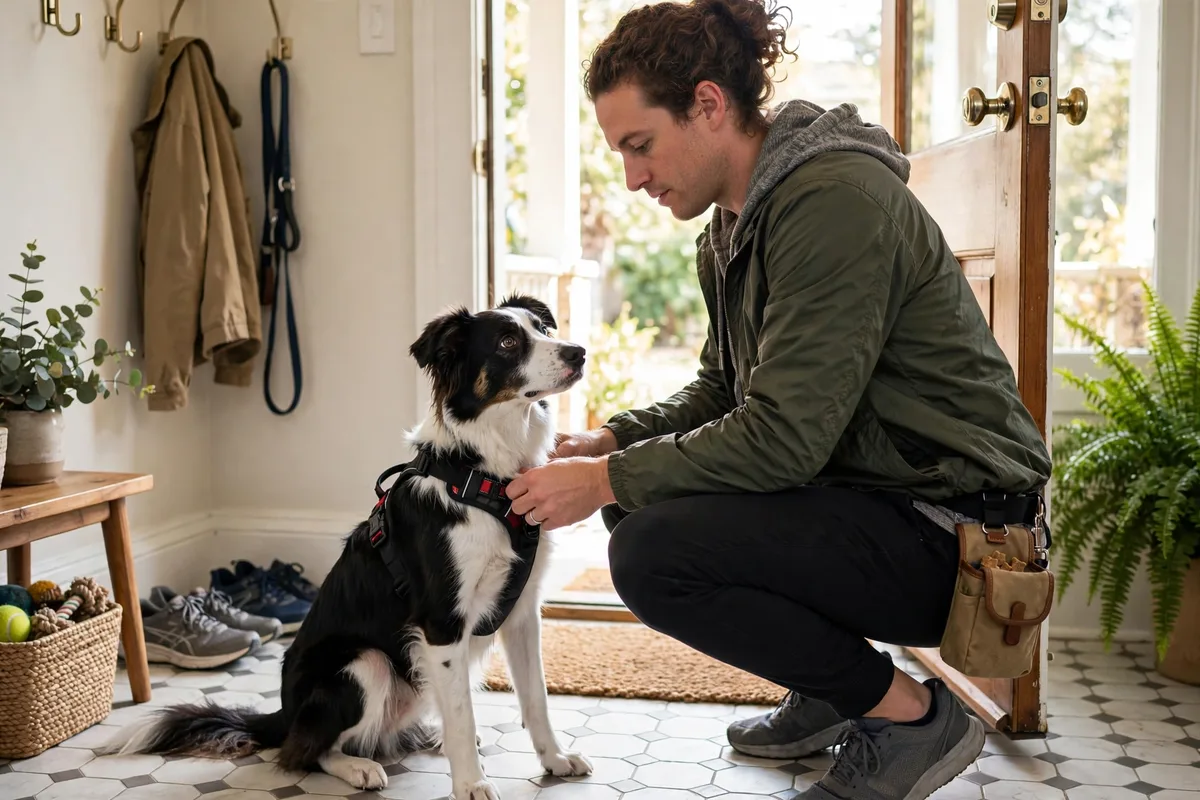
Don’t clip the leash on and head out the door on day one. Many dogs — especially puppies and rescues — find new gear strange, and a dog that’s fussing about a harness isn’t learning anything.
Over two or three days, let your dog wear the harness or collar around the house for short periods. Treat and praise calm acceptance. Clip the leash on and let it drag under supervision for a few minutes (never unsupervised — a dragging leash can snag). The goal: gear predicts treats and fun, not restraint.
Step 2: Start Indoors Where It’s Boring
Your living room is the classroom; the neighborhood is the final exam. Don’t start at the busiest park in town.
Pick the side you want your dog to walk on and be consistent — most people use the left. Hold the leash in the hand opposite the dog, letting it hang in a loose J-shape. There should always be visible slack between you and your dog. A tight leash is information flowing the wrong way; it tells the dog you’re tense, and tension travels down the leash.
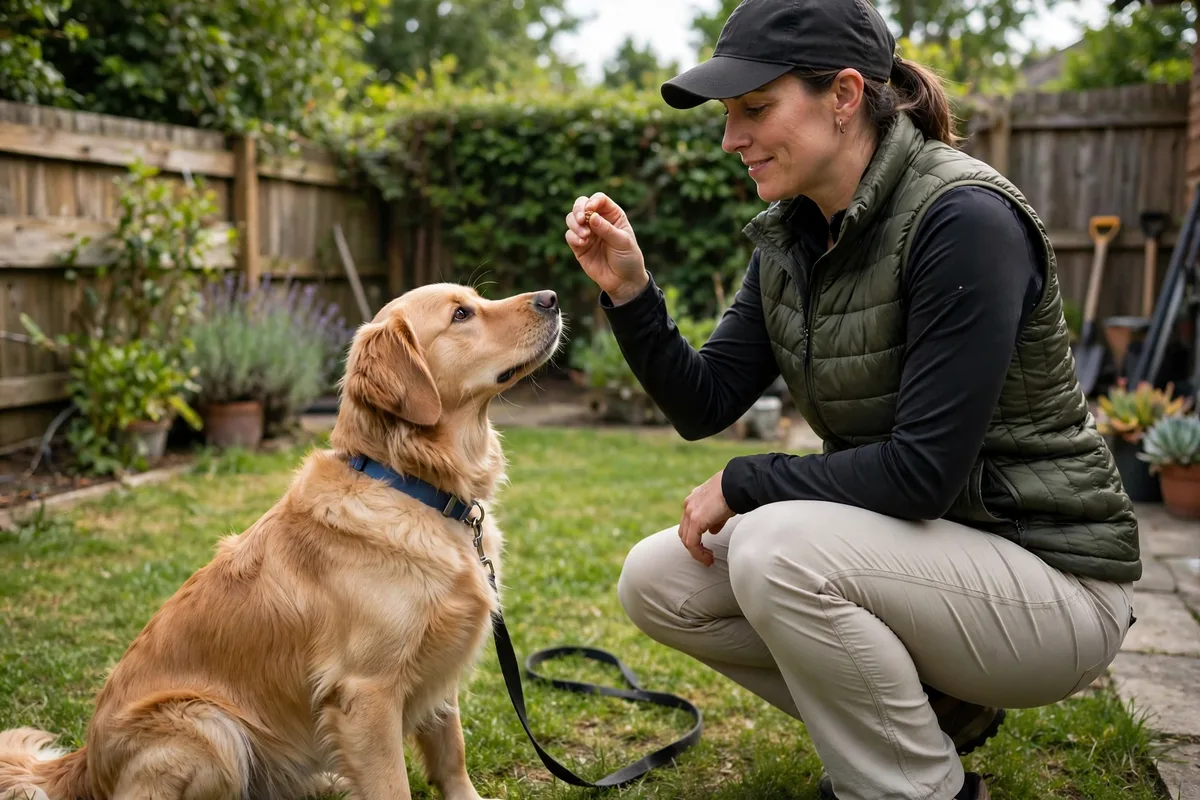
Walk a few steps across the room. If the leash stays loose, mark it (“yes”) and deliver a treat at your side, in line with the seam of your pants. Feeding at your side teaches your dog exactly where the good stuff happens: next to you, not ten feet ahead.
Step 3: Play the Stop-and-Go Game
This is the core of loose-leash training, and it’s beautifully simple: pulling stops the walk; a loose leash restarts it.
Walk forward. The instant the leash tightens, stop. Become a tree — still, quiet, boring. Don’t yank the leash, don’t lecture, don’t drag the dog back. Just wait. The moment your dog turns toward you, takes a step back, or otherwise creates slack, mark it, praise, and move forward again.
Yes, the first few sessions will feel absurd. You will take one step, stop, wait, take two steps, stop. A trip down the hallway might take five minutes. That’s normal. You’re teaching the single most important lesson in leash manners: pressure on the leash never, ever makes the walk continue. Only slack does.
Step 4: Change Direction Often
Stopping works, but some dogs need a stronger reason to pay attention. Add direction changes: every so often, turn and walk the other way. When your dog catches up and the leash goes slack, mark and reward.
This teaches your dog to watch you instead of locking onto whatever is ahead. It also keeps training sessions from becoming a slow march of stop-start frustration. Mix stops and turns freely — unpredictability from you builds attentiveness from your dog.
Step 5: Add a Walking Cue
Once your dog is staying near you with a loose leash indoors, give the walk a name. “Let’s go” is a friendly, clear choice. Say it when your dog is already in the right position, then step off and reward. Over repetitions, the cue comes to mean “walk with me on a loose leash.”
Keep your cue distinct from your release word. “Let’s go” starts the structured walk; “okay” or “free” ends it and lets the dog sniff and wander within leash range. Dogs need both modes — all business, no sniffing makes for a miserable walk.
Step 6: Take It Outside, One Level at a Time
Move through locations in order of difficulty, spending a few sessions at each:
- Your yard or driveway. Familiar, low-distraction.
- Your quiet street. New smells, mild distraction.
- A busier route. More people, more dogs.
At each new level, expect a temporary backslide. That’s not failure — it’s information. Drop back to shorter sessions and reward more often until the new location feels easy. Rushing to the hard places is the most common reason leash training stalls.
Step 7: Build Duration Between Rewards
Early on, reward every few steps. That’s not bribery; it’s building a habit. Over sessions, stretch the gap: every five steps, then ten, then a full block. Talk to your dog, praise check-ins (those moments your dog glances up at you unprompted — reward every one), and keep sessions to five or ten minutes.
The end goal isn’t a dog that needs a treat every block. It’s a dog that has learned, through hundreds of rewarded repetitions, that staying near you on a loose leash is simply how walks work.
Puppies, Strong Pullers, and Small Dogs
Puppies pick up leash manners quickly, but keep sessions to three to five minutes and let them sniff — sniffing is mental exercise, not misbehavior. A puppy that pulls toward every smell isn’t being defiant; it’s being a puppy. Reward the moments it chooses you over the smell.
Strong, determined pullers may need a front-clip harness or head halter as a management tool while training progresses. These don’t replace training — they just make it physically possible to train without getting dragged. If your large dog’s pulling is dangerous (knocking you over, lunging at traffic), consider a few sessions with a certified professional trainer for hands-on help.
Small dogs pull too, and it matters just as much — a small dog yanking on a collar can injure its trachea. A harness is the safer choice for small breeds, and the exact same training steps apply. Don’t skip training because the pulling is merely annoying rather than dangerous; small dogs deserve good manners too.
Troubleshooting Common Sticking Points
| Problem | Fix |
|---|---|
| Dog pulls constantly, stopping doesn’t help | You’re training in too hard a location — go back indoors and rebuild |
| Dog sits down and refuses to move | Don’t drag. Lure with a treat, praise tiny steps, and check the gear isn’t uncomfortable |
| Dog lunges at other dogs or people | Increase distance — cross the street if needed — and reward calm attention at a distance your dog can handle |
| Dog only walks nicely when it sees treats | Fade the visible treats: keep them in the pouch, reward from the pouch, and stretch the gaps gradually |
| Dog zigzags and wraps the leash around you | Stop, untangle calmly, and reward when the dog is back at your side — it learns position matters |
| Walks are still miserable after weeks | Check the basics: is the dog getting enough exercise overall? An under-exercised dog can’t learn calm leash skills |
If your dog shows genuine fear or aggression on walks — cowering, snapping, lunging with intent — that’s beyond leash manners and into behavior territory. Talk to your vet and consider a certified behavior professional rather than pushing through.
Frequently Asked Questions
How long does leash training take?
Most dogs show noticeable improvement within two to three weeks of consistent short sessions. Reliable loose-leash walking in distracting real-world settings typically takes a couple of months. Consistency matters more than total hours.
Should my dog walk in a perfect heel?
Not for everyday life. A loose leash with the dog roughly at your side is the goal — your dog should be allowed to sniff, look around, and be a dog. Save the formal heel for crossing streets and tight spaces.
Are head halters cruel?
When fitted correctly and introduced gradually with treats, head halters are a humane management tool — they’re similar to a horse’s halter and work by steering, not pain. But they’re a tool, not a teacher: use one alongside training, not instead of it. And never jerk a leash attached to a head halter.
My dog walks fine until it sees a squirrel. Then all bets are off. Help?
Squirrels are the final boss of leash training. Practice at distances where your dog notices the squirrel but can still respond to you, and reward that choice heavily. Over sessions, that distance shrinks. Management matters too — there’s no shame in crossing the street.
Better Walks Start With a Looser Leash
Leash manners come down to one rule your dog can understand: a tight leash stops the fun, and a loose leash keeps it going. Start indoors, keep sessions short, reward generously, and move to harder locations only when the easy ones feel boring. Your reward is walks you actually look forward to — and a dog that’s calmer, better exercised, and easier to live with. Pair these skills with a solid daily walking routine, and the leash becomes the best part of both your days.

Pingback: Daily Dog Walking Routine: Build One That Actually Sticks