
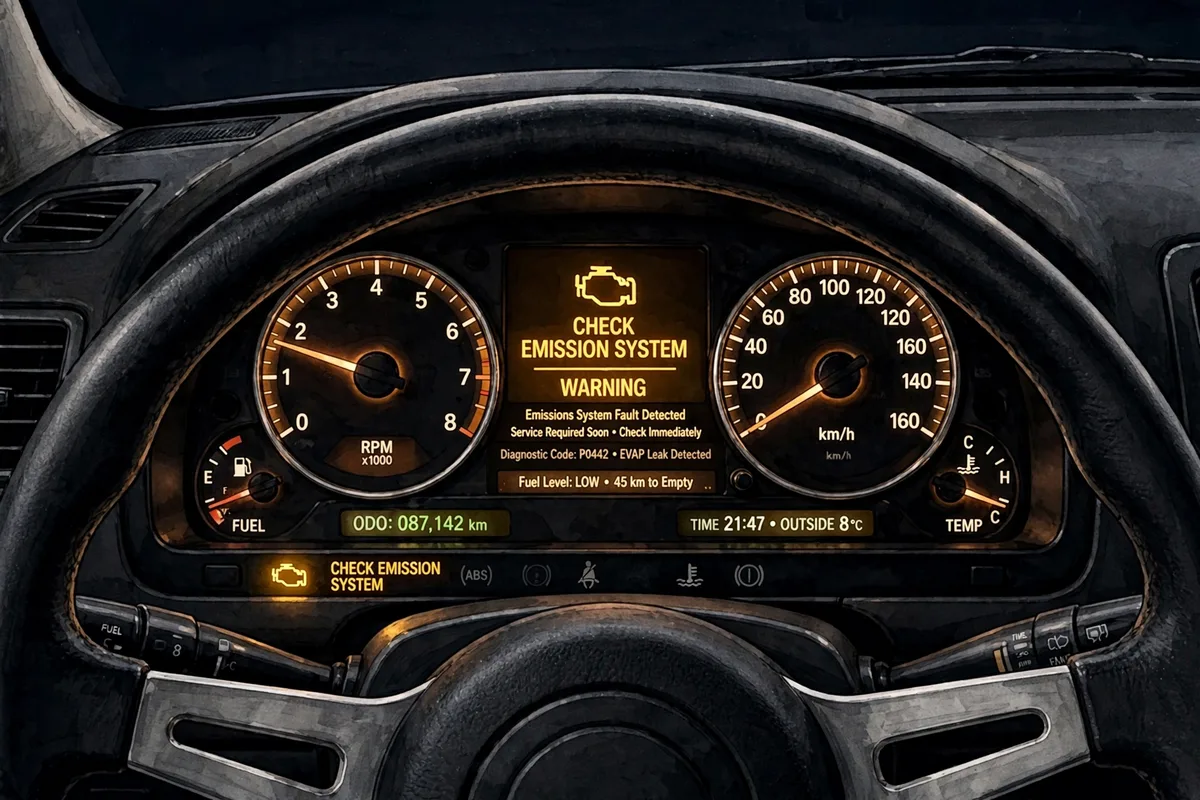
Few dashboard messages cause as much immediate anxiety as “Check Emission System.” It sounds expensive, vaguely environmental, and urgent — and while you shouldn’t ignore it, it also doesn’t automatically mean your car is falling apart. This warning covers a whole family of problems, from a gas cap you forgot to click shut to a failing catalytic converter.
Here’s what the message actually means, the most common causes ranked from cheapest to priciest, what to do when it appears, and how to tell whether you can keep driving or need a shop right away.
What Does “Check Emission System” Mean?
Your car’s emission control system manages the harmful gases and pollutants coming out of the exhaust. It’s not one part — it’s a network of components including the catalytic converter, oxygen sensors, the evaporative emissions (EVAP) system, the exhaust gas recirculation (EGR) valve, and the mass airflow sensor, all monitored by the engine’s computer.
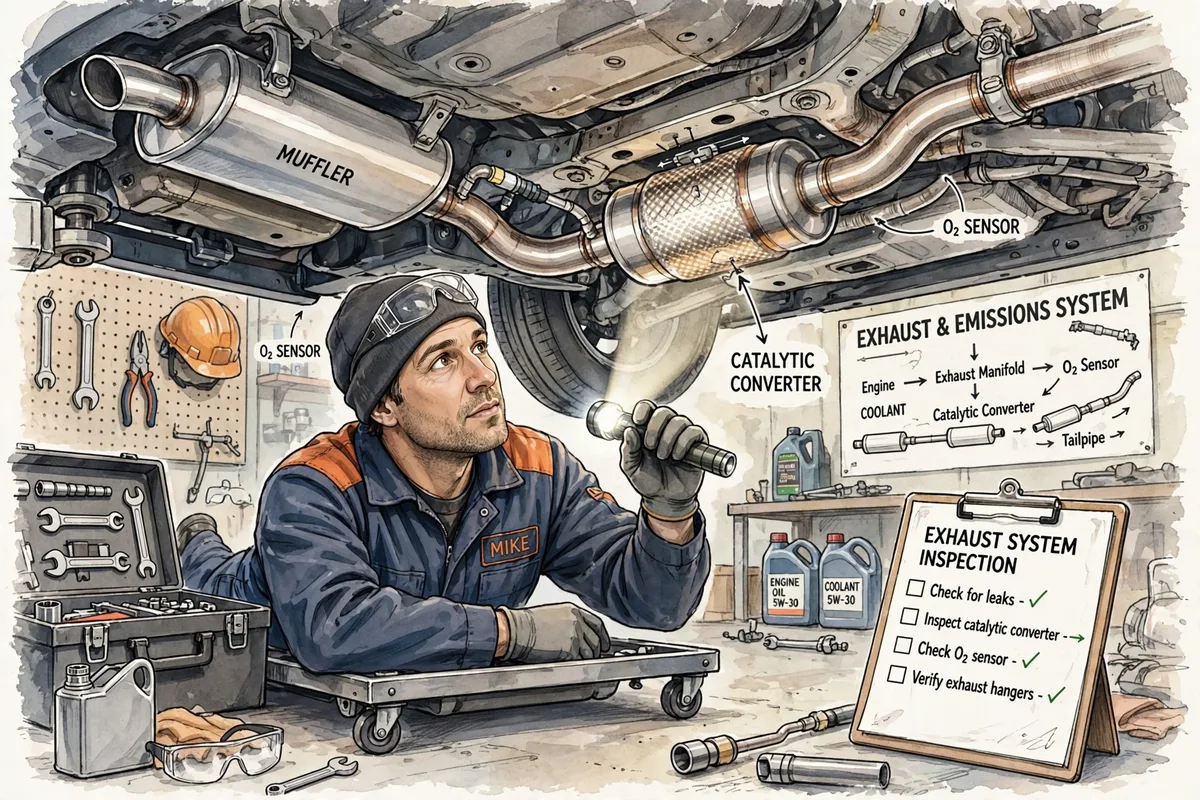
When the “Check Emission System” light or message appears, it means the onboard diagnostics system has detected that emissions are outside normal parameters. In plain terms: something in that network isn’t working as designed, and the car is likely releasing more pollutants than it should.
On many vehicles this warning is essentially a version of the check engine light, focused specifically on emissions-related faults. On others — notably many Honda and Acura models — it appears as its own dedicated message alongside or instead of the check engine light.
The Most Common Causes (Cheapest First)
1. Loose, damaged, or missing gas cap
This is the number one cause and the cheapest fix. The gas cap seals the EVAP system, which captures fuel vapors from the tank and routes them to the engine to be burned. If the cap isn’t clicked shut — or its rubber gasket is cracked — the system detects a pressure leak and triggers the warning.
What to do: Remove the cap, inspect the gasket, and retighten it until it clicks several times. The light often won’t clear immediately; the system typically needs one to three full drive cycles (engine fully warming up and cooling down) to re-test the EVAP seal and turn the light off by itself.
2. Faulty oxygen (O2) sensor
Oxygen sensors measure how much oxygen is in the exhaust stream and tell the engine computer how to adjust the air-fuel mixture. When one fails, the engine runs too rich or too lean — wasting fuel and spiking emissions. A bad O2 sensor is one of the most common reasons for a persistent emissions warning.
Signs: worse gas mileage, a rotten-egg smell from the exhaust, rough idling.
3. Failing catalytic converter
The catalytic converter transforms harmful exhaust gases into less harmful ones. It’s expensive to replace, and it usually doesn’t fail on its own — it fails because an upstream problem (like a bad O2 sensor or engine misfires sending unburned fuel into the exhaust) was ignored. This is why addressing an emissions warning promptly matters: a cheap sensor fix today prevents a very expensive converter replacement later.
4. EVAP system leaks or faults
Beyond the gas cap, the EVAP system includes the charcoal canister, purge valve, and vent solenoid. A cracked hose, stuck valve, or saturated canister will trigger the warning. These faults often produce specific diagnostic codes pointing right at the failed component.
5. Mass airflow (MAF) sensor problems
The MAF sensor measures incoming air so the computer can meter fuel correctly. A dirty or failed sensor throws off the air-fuel balance, increasing emissions and often hurting performance and fuel economy. Sometimes a simple cleaning with MAF sensor cleaner resolves it.
6. EGR valve issues
The exhaust gas recirculation valve routes a measured amount of exhaust back into the intake to reduce nitrogen oxide emissions. Carbon buildup can stick it open or closed, triggering the warning and often causing rough idling or stalling.
7. Spark plugs, ignition coils, and vacuum leaks
Engine misfires from worn spark plugs or failing coils send unburned fuel into the exhaust — an emissions problem and a catalytic converter killer. Vacuum leaks lean out the mixture with similar effects. These tend to come with noticeable drivability symptoms: shaking, hesitation, or stalling.
What to Do When the Light Comes On
Follow this sequence before assuming the worst:
- Check the gas cap first. Tighten it until it clicks. If the gasket looks cracked or the cap is missing, replace it — it’s a cheap part.
- Note how the car is behaving. Is it driving normally, or is it shaking, lacking power, or stalling? Normal behavior suggests a minor fault; drivability symptoms suggest something more serious.
- Check whether the light is steady or flashing. A steady light means a fault that should be checked soon. A flashing check engine or emissions light means an active misfire that can destroy the catalytic converter — reduce speed, avoid hard acceleration, and get to a shop promptly.
- Get the codes read. An OBD-II scan reveals the specific fault code, which narrows the cause enormously. Many auto parts stores read codes for free, and inexpensive Bluetooth OBD-II adapters pair with phone apps for DIY diagnosis.
- Don’t just clear the code and hope. Disconnecting the battery or clearing codes without fixing the cause only hides the problem — the light will return, and you’ll still fail an emissions or smog test.
Can You Keep Driving With the Light On?
Usually, yes — for a while. A steady “Check Emission System” light with no drivability symptoms typically means the car is safe to drive to a shop within a few days. But don’t treat it as a permanent dashboard decoration:
- Fuel economy will suffer until the underlying issue is fixed.
- The catalytic converter is at risk if the root cause is a misfire or bad sensor — and that’s the expensive part.
- You’ll fail emissions testing in states that require it, which means no registration renewal until it’s fixed.
- Small problems become big ones. A $30 gas cap ignored can mask a failing O2 sensor, which then kills a $1,000+ catalytic converter.
If the light is flashing, or the car is shaking, stalling, or has suddenly lost power, don’t keep driving normally — get it checked the same day.
Preventing Emissions Problems
Most emissions faults are maintenance problems in disguise. A few habits keep the system healthy:
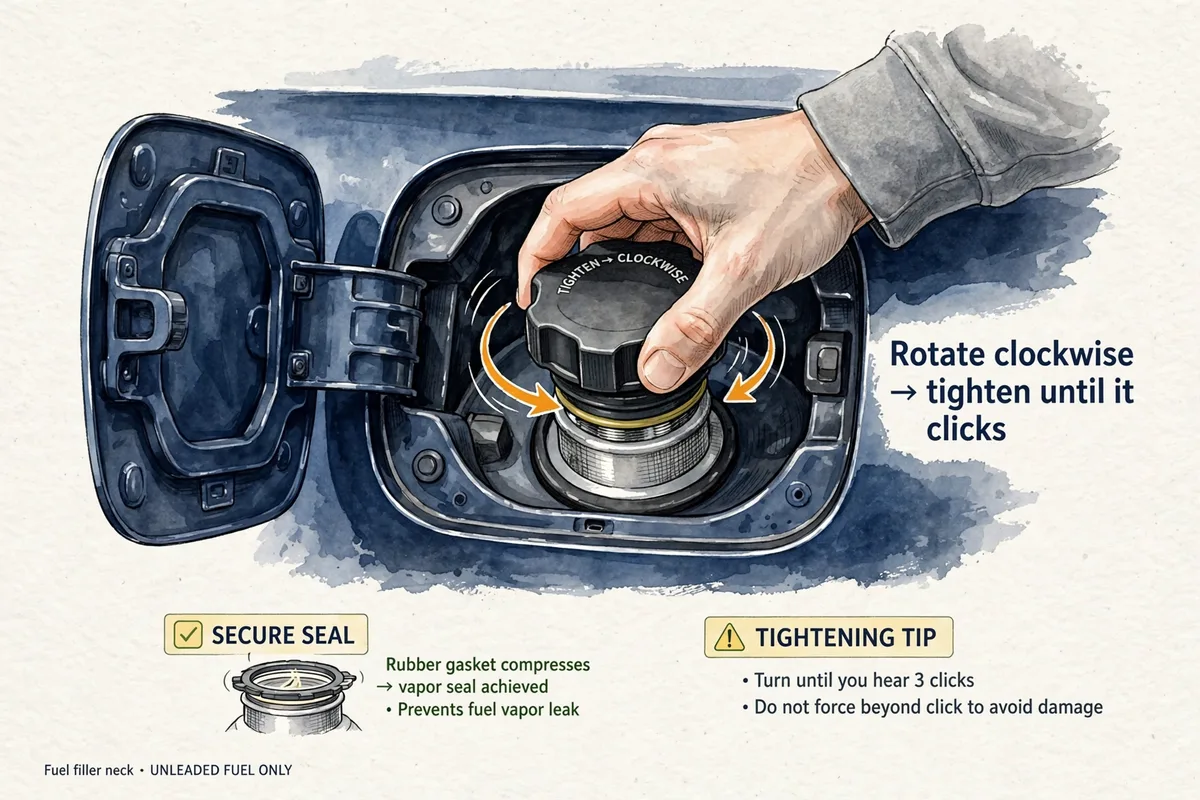
- Tighten the gas cap properly every time you fuel up — three clicks is the rule of thumb.
- Replace spark plugs on schedule per your owner’s manual, not when they fail.
- Don’t ignore a check engine light for months; upstream faults cascade into converter damage.
- Use the fuel grade your manufacturer recommends and avoid letting the car sit for months with old fuel in the tank.
- Fix exhaust leaks promptly — they let oxygen into the system and confuse the sensors.
Frequently Asked Questions
Is “Check Emission System” the same as “Check Engine”?
They’re closely related. Both come from the onboard diagnostics system, and an emissions fault will often trigger the check engine light too. Some manufacturers display the emissions-specific message to narrow down the fault category.
How much does it cost to fix?
It ranges enormously: a gas cap costs very little, an oxygen sensor is a moderate repair, and a catalytic converter replacement is one of the most expensive common repairs. That’s why a diagnostic scan matters — it tells you which end of that range you’re on before a shop starts replacing parts.
Will the light go off by itself?
Sometimes. If the cause was a loose gas cap and you’ve tightened it, the system may clear the light after a few drive cycles. If the underlying fault persists, the light stays on.
Can I pass an emissions test with the light on?
No. In states with emissions or smog testing, an illuminated emissions warning is an automatic failure. The fault must be repaired and the system’s readiness monitors must complete their self-tests before the car will pass.
Does cold weather trigger the light?
Cold starts put extra load on sensors and the EVAP system, and a marginal component that’s fine in summer can trip the warning on a freezing morning. If the light appears only in extreme cold and clears on its own, mention it to your mechanic — but still get the codes checked.
For another dashboard warning that confuses drivers, see service StabiliTrak meaning, and if your drive involves highway miles, our guide on how to turn on fog lights covers low-visibility driving.