

Bedtime doesn’t have to be a nightly negotiation. A consistent bedtime routine — the same calming steps, in the same order, at roughly the same time each evening — is one of the most effective ways to help children fall asleep faster and stay asleep longer. The routine works because it signals to your child’s brain that sleep is coming, turning bedtime from a battle into a habit. Here’s how to build one that fits your family.
Why Bedtime Routines Work
Children, especially young ones, find comfort in predictability. When the evening follows the same pattern night after night, your child’s body and mind start winding down before you even say “lights out.” Think of the routine as a dimmer switch rather than a light switch: each step gradually moves your child from daytime energy toward sleep. Research and child sleep organizations alike emphasize the same point — consistency matters more than perfection. A simple routine done every night beats an elaborate one done twice a week.
How to Create a Bedtime Routine in 7 Steps
Build the routine once, write it down, and keep it to about 30–45 minutes from start to sleep.
1. Set a bedtime and work backward
Choose a realistic bedtime based on when your child needs to wake up. For children up to about five, that often means a bedtime between 7 and 7:30 p.m.; for school-age children up to about 12, between 8 and 9 p.m. Then count backward: if bedtime is 8 p.m., the routine starts around 7:15. Keep wake-up time consistent too — including weekends — because a steady body clock is half the battle, according to The Sleep Charity.
2. Start the wind-down 30–45 minutes before bed
Dim the lights and switch off screens when the routine begins. Screens suppress melatonin, the hormone that signals sleepiness, so ending screen time here makes the rest of the routine easier. This is also where a family screen-time agreement pays off: if evenings have a clear “screens off” time, nobody argues about it.
3. Let your child choose the calm activity
Offer two quiet options — a puzzle, coloring, or listening to calm music — and let your child pick. Giving them a small choice builds cooperation without turning bedtime into an open-ended negotiation. Keep the activity gentle: no roughhousing, competitive games, or new exciting toys this late in the evening.
4. Do a relaxing bath, then pajamas
A warm bath about 30 minutes before bed can genuinely help: the drop in body temperature afterward promotes sleepiness. Every-night baths aren’t mandatory, though — a warm washcloth wipe-down and tooth-brushing works on busy nights. After the bath, pajamas go on. That physical change of clothes is itself a cue: the day is over.
5. Run through hygiene, then a drink and bathroom
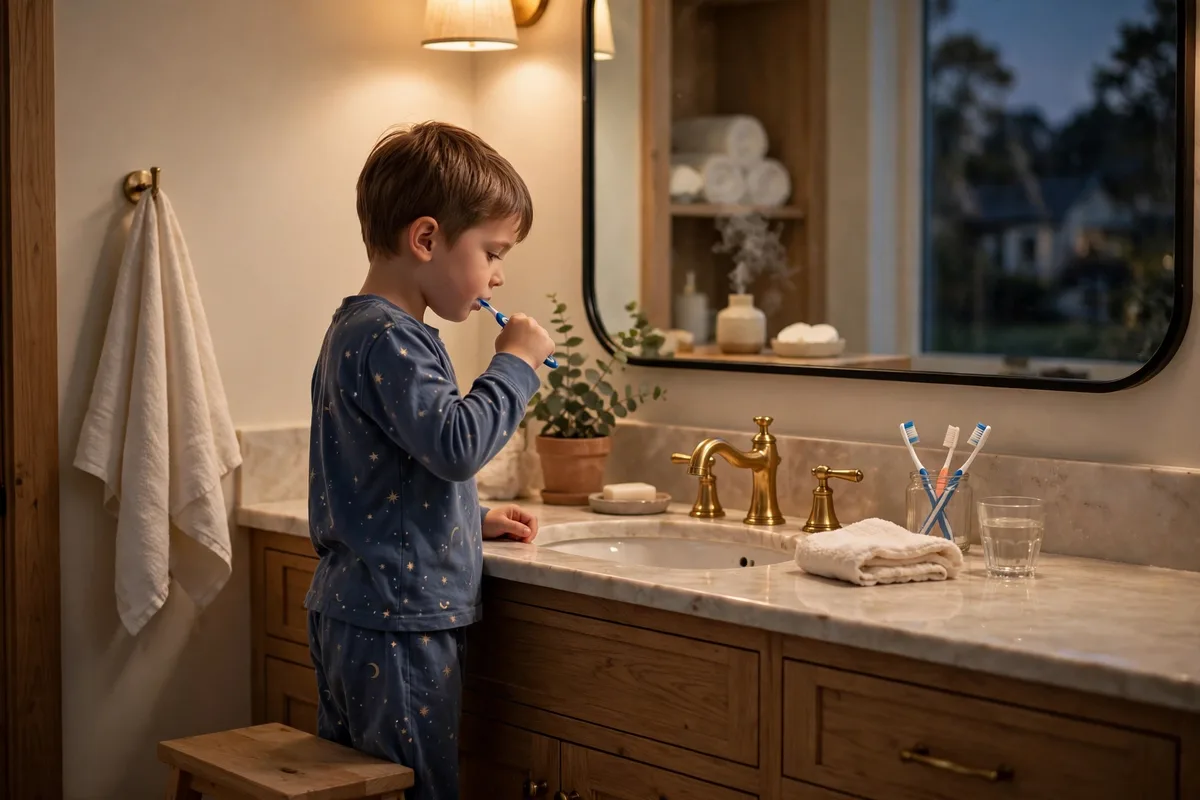
Keep the same short sequence: brush teeth, use the bathroom, get a small drink of water. Children stall at this stage partly because it’s boring — a two-minute sand timer or a brushing song keeps it moving without you having to nag.
6. Share the in-bed ritual
This is the part your child will remember. Spend 10–15 minutes in bed with a story, a quiet chat about the day, or your child reading to you. For older independent readers, let them read on their own for a set time before lights out. Keep the conversation positive — save behavior lectures and tomorrow’s logistics for earlier in the evening.
7. End with the same loving goodbye
Finish with a consistent sign-off every single night: a kiss, a hug, a special phrase, or arranging a stuffed animal just so. This reliable ending gives your child the emotional security to let go of the day. Then leave the room with the lights low (a nightlight is fine if your child is afraid of the dark).
Sample Bedtime Routines by Age
Adjust the sequence to your child’s age and your family’s schedule:
| Step | Toddler (1–3) | Preschool (3–5) | School-age (6–12) |
|---|---|---|---|
| Wind-down | 5-min warning, pick one quiet toy | Visual chart, choose calm activity | Screens off, pack schoolbag for tomorrow |
| Bath | Warm bath or washcloth wipe | Bath or shower | Shower (older kids) |
| Pajamas + hygiene | Diaper/pull-up, brush teeth with help | Brush teeth, bathroom, wash face | Brush teeth, bathroom |
| In-bed ritual | 2 short books, song, cuddle | 1–2 books, “best part of the day” chat | Reading alone or together, 15 min |
| Goodbye | Same phrase + kiss, nightlight | Hug, stuffed animal lineup | Check-in, brief chat, lights low |
Bedtime routines pair naturally with mornings: once evenings run smoothly, you can build a matching family morning routine so both ends of the day feel predictable.
What to Avoid
A few common habits that quietly work against sleep:
- Screens in the final stretch: end all screens at the start of the routine, not right before lights out.
- Big evening meals: a light snack is fine and can help; a heavy late dinner is not.
- Emotionally charged topics: arguments, big news, and tomorrow’s worries belong earlier in the evening.
- Starting too late: an overtired child falls asleep slower, not faster. If your child is regularly melting down at 8 p.m., the bedtime may need to move earlier, not later.
- Reinventing it nightly: the whole point is repetition. Don’t add new steps to fix a rough night — stick with the sequence for at least two weeks before judging it, as The Sleep Charity recommends.
Safe Sleep Basics for Babies
If your routine is for an infant, the AAP’s safe sleep guidance is the non-negotiable foundation: always place babies on their backs to sleep, on a firm, flat sleep surface such as a crib or bassinet, with no pillows, blankets, bumper pads, or soft toys in the sleep space. Room-share (baby in their own sleep space in your room) for at least the first six months; never bed-share on a couch or armchair. Keep the room at a comfortable temperature to avoid overheating. These apply to every sleep — naps and nights alike.
When Bedtime Goes Off Track
Even good routines hit rough patches. Travel, illness, daylight saving time, and developmental leaps all disrupt sleep temporarily — the fix is usually to return to the familiar sequence as soon as things settle, not to redesign the routine. For repeated stalling (“one more story,” endless bathroom trips), set the limit once, kindly and in advance: “Two books tonight, then lights out.” For children who keep getting out of bed, walk them back calmly with minimal talking and no rewards for the escape. And if more than one child shares the routine, stagger their bedtimes by 15–20 minutes so each gets their own calm wind-down with you.

The Bottom Line
Creating a bedtime routine for children comes down to three things: a consistent start time, the same calming sequence every night, and a loving, predictable ending. Write it down, post it where everyone can see it, and give it at least two weeks to take hold. Once bedtime is handled, the story you read together each night can become a stepping stone to bigger habits — like helping your child build a lasting reading habit one chapter at a time.


Pingback: How to Build Lasting Reading Habits in Your Kids: A Parent's Guide