
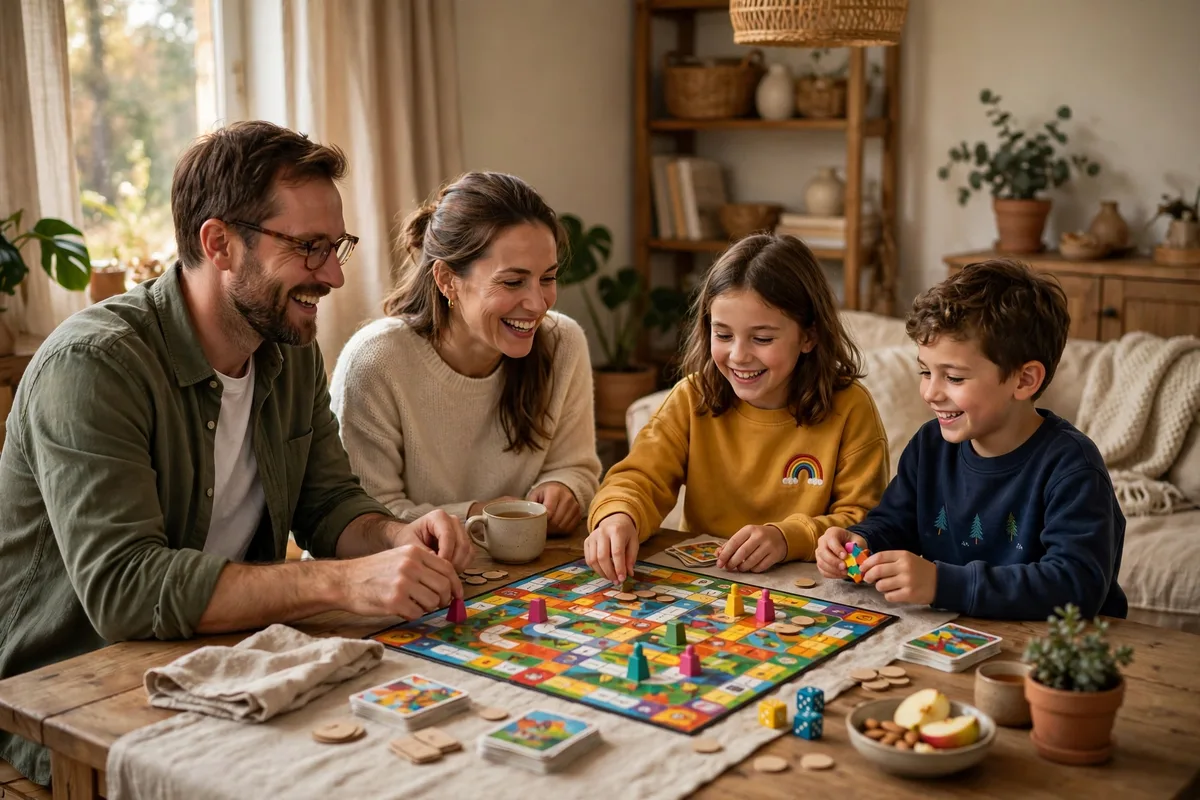
A screen-free family tradition is any recurring activity your family does together with phones put away — a weekly walk, a monthly game night, a seasonal campout. Traditions give children something to anticipate and remember, and making them screen-free is what makes them actually happen instead of everyone half-watching a show in the same room.
Here is how to start traditions your family will keep, even with teenagers and packed schedules.
Step 1: Start Small and Simple
The biggest mistake families make is launching something elaborate — a full screen-free weekend or a complicated weekly ritual — and burning out by week three. Start with one simple, repeatable activity that fits into life you already live:

- A Friday evening walk after dinner
- A Sunday pancake breakfast where phones stay in another room
- A monthly game night (first Saturday of the month)
- A weekly taco night or breakfast-for-dinner night where everyone cooks together
Pick something so easy it feels silly. The goal of the first month is not impressiveness — it is repetition. A simple tradition that happens every week beats a spectacular one that happens once.
Step 2: Give Everyone a Role
Children — especially teenagers — engage far more when they have a job rather than being spectators. Rotate responsibilities each time:
- Meal traditions: one person picks the recipe, one shops for ingredients, one cooks, one sets the table
- Walk traditions: kids take turns choosing the route or the post-walk snack stop
- Game nights: a different person picks the game each time
- Seasonal traditions: let kids plan part of the outing
Even young children can have real roles: the youngest sets the table, the middle child picks the music. When everyone contributes, the tradition belongs to everyone — and nobody is just waiting for it to end.
Step 3: Set Clear, Fair Screen Rules
Traditions only work if the rules are explicit and apply to everyone. Vague intentions (“let’s try to be off our phones”) fail; clear agreements work:
- Define what counts: phones, tablets, TV, gaming — name them all
- Define the window: “from 6 p.m. to bedtime on Fridays” is clearer than “tonight”
- Make it universal: parents follow the rules too. If kids catch you sneaking a peek at a screen, the tradition loses all credibility instantly
- Allow sensible exceptions: keep one phone accessible for emergencies or navigation; the point is connection, not suffering
Writing the agreement down — even informally — helps. If your family has not yet done one, our guide to planning a family screen time agreement covers the full process.
Step 4: Build It Into the Week (or Month)
Traditions need a fixed slot or they evaporate. Anchor yours to something that already happens:
- After dinner on a specific day
- Saturday morning before the day fills up
- The first weekend of each season
- A specific date each month (the 15th, for example)
Put it on the calendar like any other commitment, and post it on your family command board so nobody schedules over it. Regularity is what transforms an activity into a tradition — children begin to expect it, and that expectation is what makes it special.
Step 5: Expect (and Plan for) Resistance
Especially in the first few weeks, expect complaints — particularly from kids used to constant screens. This is normal and temporary. Plan for it:
- Acknowledge the feeling: “I know it’s hard to put the phone down. I find it hard too.”
- Have the next activity ready: when restlessness hits, offer two options — “Would you rather cook or play outside? Craft or a game?” Restless kids need a redirect, not a lecture.
- Make the alternative genuinely good: the activity has to be at least as appealing as what they gave up. Boredom kills traditions faster than any phone does.
- Start with shorter sessions: a 45-minute tradition you all enjoy beats a 3-hour one everyone endures
Most families find the resistance fades after two or three repetitions, once kids start anticipating the fun instead of missing the screens.
Twelve Tradition Ideas to Steal
Weekly (low effort)
- Screen-free dinner club — everyone cooks one dish together once a week
- Friday walk — same time, rotating route-choosers, end with ice cream sometimes
- Family read-aloud — one chapter a week of a longer book; try our family reading challenge for structure
Monthly (medium effort)
- Game night championship — rotating game picker, a running scoreboard, a silly trophy
- Adventure day — a different park, trail, museum, or neighborhood each month; see our ideas for planning a low-cost family activity
- Cook the world — each month, cook a meal from a different country together
- Stargazing night — blankets in the backyard, a free star-map app used once at the start, then phones away
Seasonal (big moments)
- Backyard campout — tents, marshmallows, stories; no need to travel
- Seasonal bucket list — write the season’s must-dos on the board and check them off (apple picking, sledding, first swim)
- Photo night — go through old family albums together; this is also a perfect prompt for keeping family photos organized
- Volunteer together — a park cleanup, food bank shift, or care-package assembly; a tradition that builds perspective
- Gratitude ritual — at holiday meals, each person shares one thing they are grateful for; write them down and keep them
Step 6: Review and Evolve
After a month or two, ask everyone: what is your favorite part? What would you change? Traditions that evolve with the family last; rigid ones die when kids’ ages and interests change. A toddler’s pancake breakfast becomes a teenager’s late-night diner run — that is the tradition surviving, not failing.

Keep a simple record: a photo from each game night, a list of countries you have cooked, a tally of books read aloud. Years later, that record becomes one of your family’s most treasured things.
The Bottom Line
Screen-free family traditions work when they are simple enough to repeat, owned by everyone, protected by clear rules, anchored to a fixed slot, and allowed to evolve. Start with one tiny tradition this week — a walk, a breakfast, a game — and let it grow. The screens will still be there afterward. The memories will not make themselves.
For more activity ideas and planning tips, see MomsWhoThink’s guide to planning a screen-free family weekend.


Pingback: How to Plan a Low-Cost Family Activity (7 Simple Steps)