

A family reading challenge turns reading into something the whole household does together instead of another item on the homework list. The idea is simple: everyone picks books, sets a goal, tracks progress side by side, and celebrates at the finish line. When children see their parents reading too, reading stops feeling like a chore assigned to them and starts feeling like a family habit.
Here is how to build a challenge your family will actually finish — and want to repeat.
Step 1: Hold a Family Kickoff Meeting
Start the challenge with a short, fun planning session. This is not about assigning homework; it is about giving everyone ownership. Over a snack or on a family walk, talk through three questions:
- What kind of challenge do we want? A book-count challenge (“read 50 books this summer”), a time challenge (“read for 20 minutes every day”), or a themed challenge (see the ideas below).
- How long will it last? Four to six weeks is a good length for the first one — long enough to build a habit, short enough that nobody loses steam.
- What counts as reading? Decide together. Picture books, chapter books, comics, audiobooks, magazines, and being read to should all count. For pre-readers, time spent looking at books or listening to read-alouds counts fully.
Let every family member, including the youngest ones, suggest and vote on the format. A challenge your children helped design is one they will stick with.
Step 2: Set Goals That Fit Each Reader
One family goal brings everyone together, but individual goals keep it fair for readers of different ages and abilities. A good approach:
- A shared family goal — for example, “As a family, we will read 30 books” or “We will read together for 200 minutes this month.”
- Personal goals matched to each person — a new reader might aim for 10 picture books, an older sibling for 3 chapter books, and a parent for one novel.
- A stretch goal for the adventurous — optional and celebrated extra.
Keep goals realistic. It is better to hit a modest goal and set a bigger one next time than to set an impossible one and quit. If you are helping children build reading habits from scratch, lean toward time-based goals (“15 minutes a day”) rather than page counts, which can feel punishing to reluctant readers.
Step 3: Make Progress Visible
A challenge you cannot see is easy to forget. Put a tracker somewhere the whole family sees it every day — the refrigerator, a hallway wall, or your family command board. Some ideas:
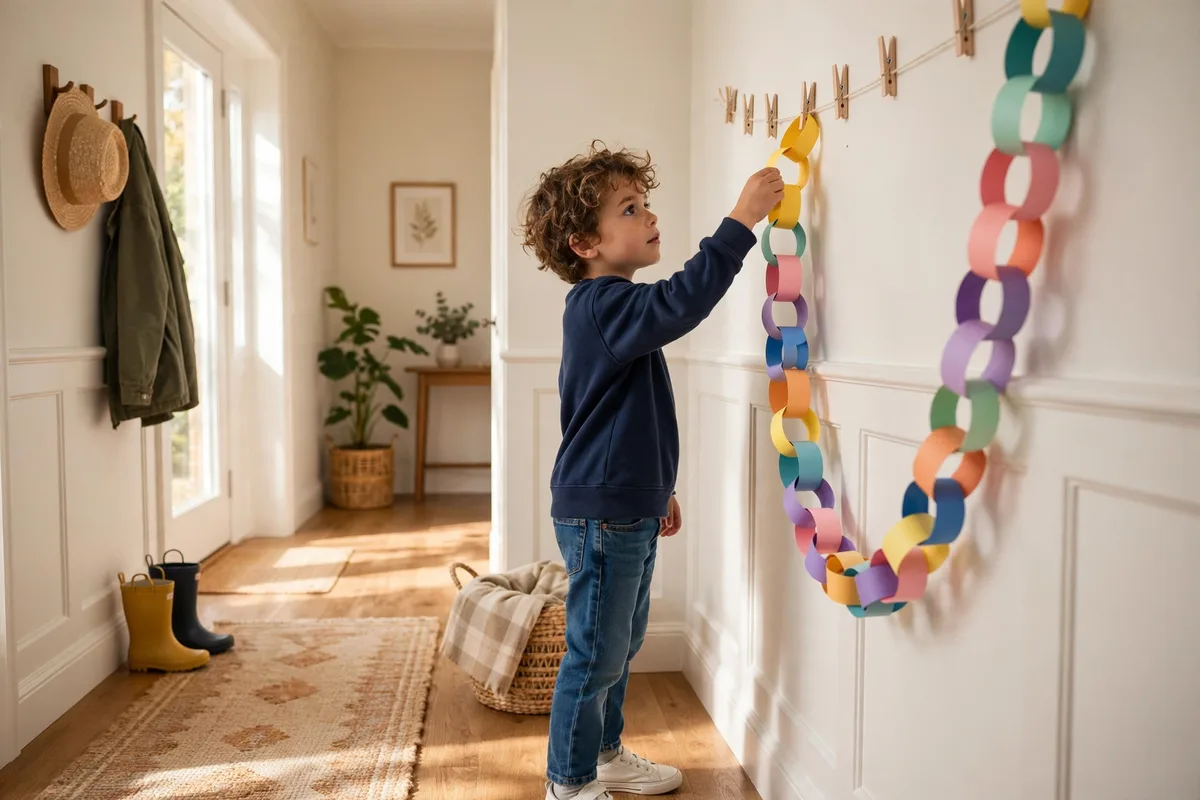
- A paper chain: add one link for every book finished and watch it grow across the room.
- A reading thermometer: color in sections as you get closer to the goal.
- Reading bingo cards: squares for different genres, formats, or themes (“a book set in another country,” “a funny book,” “a nonfiction book”).
- A simple log: title, author, and date finished — with a star column for favorites.
Let kids color, sticker, and decorate the tracker. The messier and more personal it gets, the more invested they become.
Step 4: Pick the Books Together
Take a library trip as the challenge’s first outing and let everyone choose their own stack. Librarians are excellent at matching reluctant readers with books they will love — a librarian once finding the right graphic novel can do more for motivation than any reward chart. A few tips:
- Let kids choose, even if you would not choose the same books. Choice is the single biggest motivator.
- Offer read-alouds: parents can read chapter books aloud to children who listen at a higher comprehension level than they can read on their own. It counts, and it is often the most enjoyable part.
- Mix formats: audiobooks for car rides, comics for reluctant readers, nonfiction for the dinosaur-obsessed. All reading is real reading.
- Keep books within reach: put baskets of books in the living room, the car, and by the bed, not just on one shelf.
Step 5: Build Reading Into the Day
A challenge needs a daily trigger or it fades after week one. Attach reading to something that already happens:
- Bedtime read-aloud — many families find this the easiest slot to protect, and it doubles as a calm bedtime routine for children.
- A “screen-free reading hour” — one evening a week where screens go off and everyone reads at the same time. This works especially well as one of your screen-free family traditions.
- Mealtime reading — a chapter at breakfast or during a slow weekend lunch.
- Car and waiting time — keep audiobooks ready for drives and books in a bag for appointments.
Protect at least one slot as non-negotiable family reading time. The consistency matters more than the length.
Step 6: Plan Milestones and a Finish-Line Celebration
Big goals feel distant; milestones keep energy up along the way. Celebrate at a quarter, halfway, three-quarters, and the finish line with small rewards: a special dessert, a family movie night, a trip to the bookstore, or a picnic at the park. Many families pick one big celebration for the end — a book party with themed snacks, or each person acting out their favorite scene.
Announce the celebration at the kickoff meeting so everyone knows what they are working toward. Keep rewards experience-based (an outing, a special activity) rather than stuff, and make the celebration about finishing together, not about who read the most.
Five Family Reading Challenge Ideas
Once you have done one challenge, here are formats to try next:
| Challenge | How it works |
|---|---|
| Genre bingo | Complete a bingo card of genres and themes |
| Buddy reading | Pairs read the same book and discuss it at a weekly family chat |
| Read around the world | Read books set in different countries and mark them on a map |
| Read-aloud marathon | The whole family reads one long chapter book aloud over several weeks |
Troubleshooting Common Problems
“My child only wants to re-read the same book.” That is fine — rereading builds fluency and confidence. Count it and move on.

“One child is way ahead of the others.” Emphasize personal goals over family rankings. Offer the advanced reader a mentor role, reading aloud to a younger sibling.
“We fell behind.” Adjust the goal rather than quitting. A challenge that adapts to real life teaches persistence better than a rigid one ever could.
“My teen thinks it is babyish.” Let them set their own format — manga, audiobooks, sports biographies — and keep their goals private if they prefer. Family read-alouds of a gripping novel often win over the most skeptical teens.
The Bottom Line
A family reading challenge works when it is simple, visible, and owned by everyone. Pick a format together, set realistic personal and family goals, track progress where everyone can see it, build reading into the day, and celebrate at the finish. Start small, finish strong, and make the next one even better.
The Family Reading Partnership’s read-aloud activity guide has more ideas for making shared reading a daily habit.