
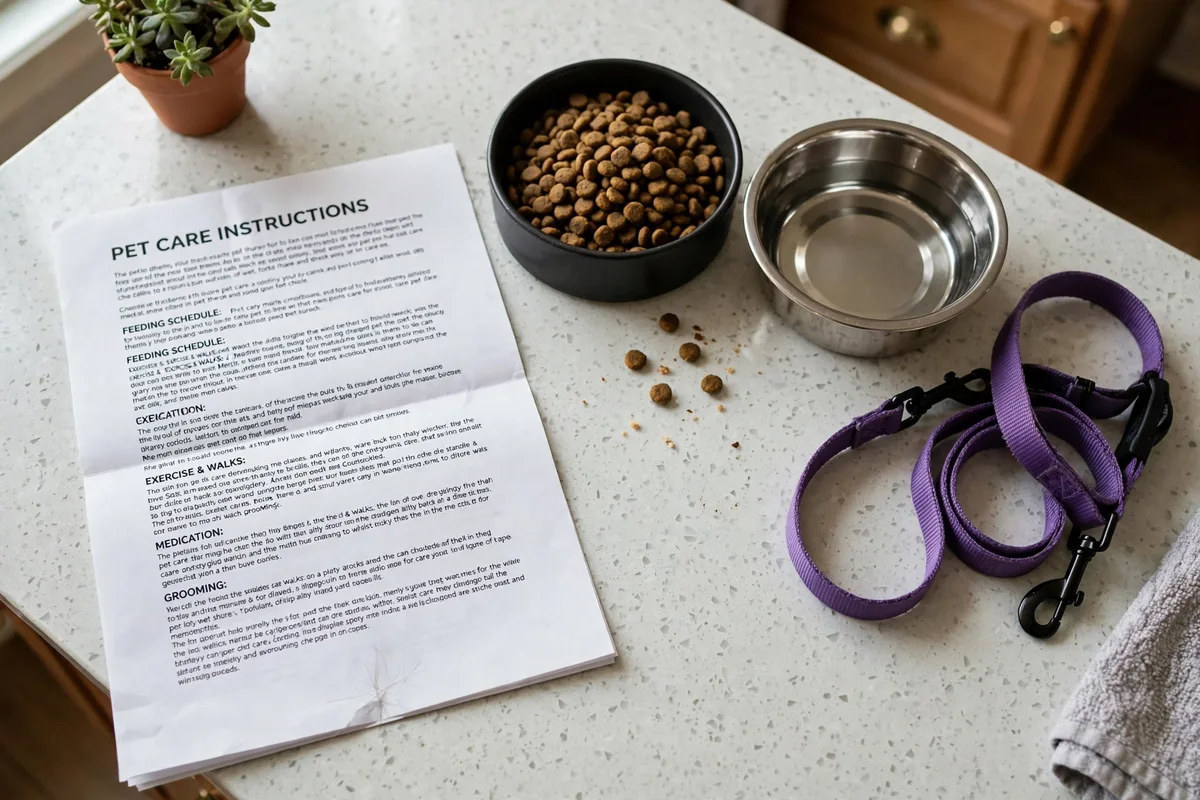
Your pet sitter knows your pet far less well than you do, and under pressure — a missed meal, a strange noise at midnight, a dog who won’t come inside — they’ll improvise. A good pet sitter guide replaces improvisation with your instructions. Here’s how to write one that actually gets used.
Why a Written Guide Beats a Verbal Download
The night-before verbal download feels thorough. It isn’t. You’re reciting a week’s worth of routine from memory while also packing, and the sitter is hearing it all for the first time while trying to look competent. Details get lost: the half-pill versus the whole pill, which door sticks.

A written guide can be checked at 6 a.m. when you’re on a plane. It also protects the sitter: clear instructions mean no guessing about your expectations, and clear emergency contacts mean fast action instead of waiting to hear back from you. If you’ve ever made a babysitter information sheet for your kids, this is the same idea, tuned for animals.
Step 1: Put the Essentials on Page One
The sitter should be able to handle an emergency after reading one page. Put this first, before anything else:
- Your contact info: cell number, email, and where you’ll be (hotel name and number if traveling).
- Backup human: a nearby friend or family member’s name and number, with a note that they have a key or know the access code.
- Your veterinarian: clinic name, address, phone number, and your pet’s name as it appears in their records.
- Emergency vet clinic: the nearest 24-hour clinic with address, phone, and driving directions from your house. Don’t assume the sitter will look this up.
- Pet’s basics: name, species, breed, age, weight, color/markings, and microchip number if chipped.
Keep a copy of this page on the fridge as well as in the guide. If you already maintain a pet emergency contact sheet, this page can be a copy of it.
Step 2: Write the Daily Routine Like a Schedule
This is the core of the guide. Write it as a timetable, not a paragraph — sitters follow schedules far better than prose.
Morning:
– Wake time and first order of business (out for the dog? litter scoop for the cat?)
– Breakfast: exact food, exact amount, where the food and measuring scoop live, where the bowl goes
– Medications with the meal, if any: which pill, what dose, how it’s given (pill pocket? peanut butter? pilling directly?)
Midday:
– Walk or play session: route, duration, which leash and harness, where waste bags are
– Any midday feeding or medication
Evening:
– Dinner with the same detail as breakfast
– Final outing, bedtime routine, where the pet sleeps and whether the bedroom door stays open or closed
Cats: litter box locations, scoop frequency, where extra litter and the scoop live. Dogs: if you’ve already written a pet feeding schedule, reference it here instead of repeating it.
Be specific about amounts. “A scoop” means nothing if the sitter grabs the wrong scoop — write “one level 1/2-cup measure” or “half a can of the chicken pâté, not the chunks.”
Step 3: Describe Your Pet Honestly
This section prevents the most common sitter surprises. Write it like you’re briefing a thoughtful stranger, because you are.
- Personality: shy with new people? Velcro dog? Aloof cat who warms up by day three? Say so, with a realistic timeline.
- Quirks and triggers: afraid of thunder, the vacuum, the doorbell. What calms them when triggered.
- House rules: allowed on the couch? In the bedrooms? The sitter should enforce your rules — consistency keeps behavior stable while you’re gone.
- Multi-pet dynamics: who eats first, who gets jealous, who must be separated at meals.
- Alarming but normal: the reverse sneeze, the 4 a.m. zoomies, the dramatic sigh before lying down. One sentence each saves a panicked 2 a.m. text.
- Never okay: table scraps, off-leash in the unfenced yard, the front door propped open. Be explicit — sitters default to being nice, and “nice” sometimes means a forbidden treat.
Step 4: Cover the House Logistics
Your sitter is operating in your house, which they don’t know. Remove every point of friction:
- Access: how they get in (key location, garage code, smart lock code) and what to do if the code fails. Test it with them present before you leave.
- Alarm system: the code, how to arm and disarm, what happens if it goes off, and the monitoring company’s number.
- Supplies map: where the food, treats, medications, leashes, litter, cleaning supplies, towels, and first-aid kit live. Label shelves if it helps.
- Thermostat: where you keep it and whether they may adjust it. Pets have been left in hot houses because the sitter didn’t know they could touch it.
- Trash and mail: trash day, where bins go, whether to bring in packages and mail.
- Cameras and visitors: disclose any indoor or doorbell cameras — required by law in many places and basic respect everywhere. Note expected visitors (cleaner, gardener) and their schedule.
- Off-limits areas: rooms or cabinets the sitter shouldn’t open.
Step 5: Write the Emergency Plan
Emergencies are when the guide earns its keep. Keep this section short and impossible to misunderstand:
- Pet injured or suddenly ill: call the emergency vet clinic first (number on page one), then call or text you. Don’t wait for a reply before seeking care.
- Pet escapes: the recall approach that works, the high-value treat location, and who to call for help searching. Note where the recent photos are.
- Home emergency (power outage, burst pipe, break-in): the backup human’s number, the alarm company, and whether the sitter should stay or leave with the pets.
- Spending authorization: state plainly that the sitter may authorize emergency veterinary care up to a dollar amount you name, and how you’ll reimburse them. A sitter who must wait for your approval while a pet is in distress is a sitter you’ve set up to fail.
Step 6: Do a Walkthrough and a Trial Run
A guide nobody has walked through is a guide nobody trusts. Schedule a meet-and-greet at your home before the trip:
- Walk the sitter through the guide page by page, in the rooms where things happen. Show, don’t just tell: this is the food bin, this is how the back door latch sticks, this is where she hides during storms.
- Watch them interact with your pet. A sitter your pet fears is the wrong sitter, no matter how good the references.
- For medication, have the sitter practice the actual administration while you watch. Pilling a cat is a skill; confirm they have it.
- If possible, book one trial visit or overnight before the real trip. You’ll discover every gap in the guide while you’re still around to fix it.
Update the guide after the trial with anything you both noticed. Then print two copies: one for the sitter, one on the fridge.
Drop-In Visits vs. Overnight Stays
The guide’s emphasis shifts with the arrangement:
Drop-in visits (sitter comes 1–3 times daily): the schedule section carries the most weight — exact visit tasks in order, since the sitter is in and out. Include how long each visit should last and what “done” looks like.
Overnight stays (sitter lives in your home): house logistics carry more weight — thermostat, trash, Wi-Fi password, food boundaries, quiet hours with neighbors. Set expectations about the sitter’s own absences: how long can the pet be left alone during the day?
Troubleshooting Guide Problems
| Problem | Try this |
|---|---|
| Guide is ten pages and the sitter’s eyes glaze over | Move detail to labeled appendices. Page one stays: contacts, schedule, emergencies. The rest is reference. |
| Sitter texts you constantly anyway | Ask what they couldn’t find, add it, and point them to the page number next time. |
| Pet won’t eat for the sitter | Normal for a day or so with a new person. Note in the guide: offer the usual food at usual times, don’t switch foods, call you if appetite is gone more than 24 hours. |
| Sitter can’t give the medication | Have them practice during the walkthrough. If they truly can’t, ask your vet about alternatives before you leave. |
| Your return is delayed | Agree in advance: the sitter’s availability, the extra fee, who decides. Put it in the guide so nobody negotiates under stress. |
| Multiple pets, sitter mixes up instructions | Give each pet a one-page profile with a photo at the top. Color-code food bins and medication bottles to match. |
Frequently Asked Questions
How long should a pet sitter guide be?
As long as it needs to be and as short as you can make it. Most guides land at 3–6 pages: one page of essentials, one to two of schedule, the rest split between pet profiles, house logistics, and emergencies. Longer than that, and you’re including nice-to-know instead of need-to-know.

Should I pay a friend who pet-sits, and should the guide differ?
Whether you pay a friend or hire a professional, the guide should be the same — professionals need your specifics just as much, and friends need the structure even more. On payment: compensate fairly, agree on the amount in writing before the trip, and include the terms in the guide.
What if my pet needs medication at exact times?
Build the sitter’s visit schedule around the medication times, not the other way around. Write the times in bold, set phone alarms together during the walkthrough, and include what to do if a dose is missed — ask your vet for that instruction, since it varies by medication.
Do I need to tell the sitter about cameras?
Yes. Disclose every camera the sitter might reasonably encounter, including doorbell cameras. It’s legally required in many states. Sitters who discover undisclosed cameras lose trust in you, and trust is the whole arrangement.
What if the sitter has an emergency and can’t come?
Ask every sitter — professional or friend — for their backup plan before you hire them, and write the backup sitter’s name and number in the guide. Your backup human from page one is your fallback if the sitter’s own plan falls through.
Write It Once, Relax the Whole Trip
A pet sitter guide feels like overkill until the first time your sitter handles a 6 a.m. feeding, a stuck back door, and a thunderstorm without texting you once. Write it this week, walk through it in person, update it after the trial run — and then go enjoy being unreachable for a while.