
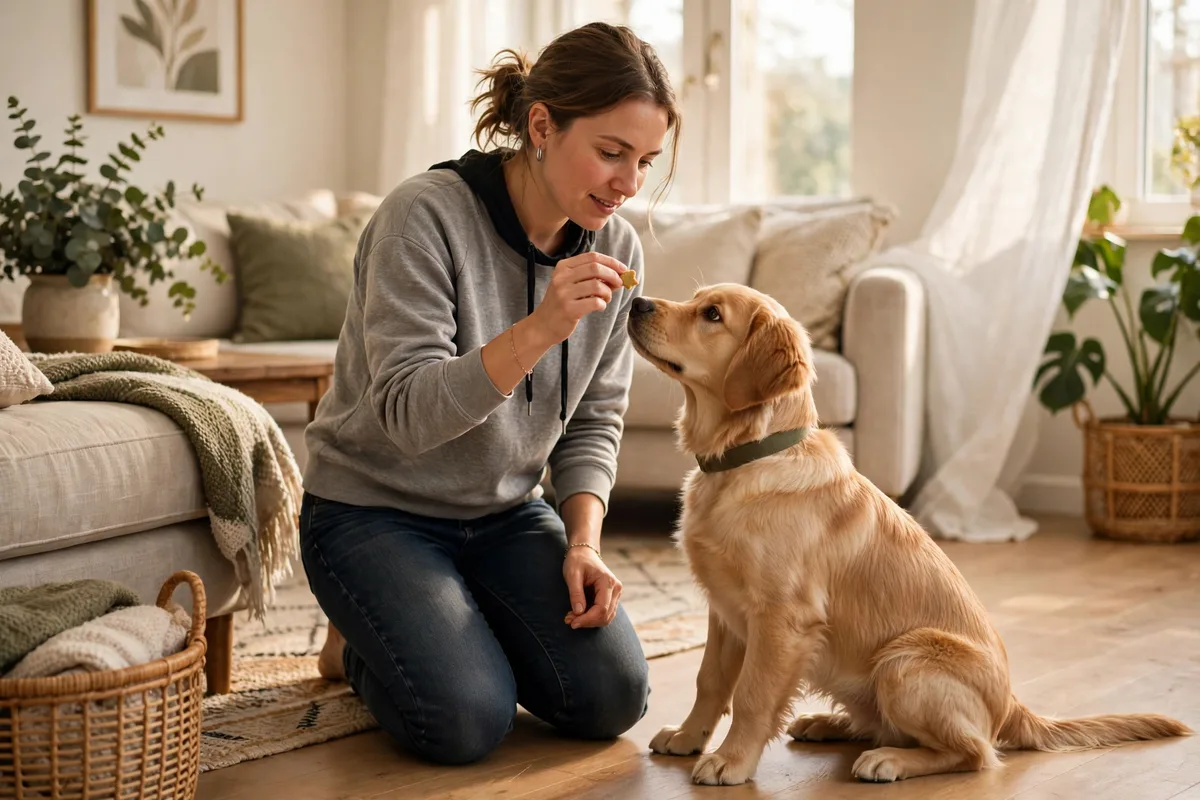
Your dog already knows how to sit. Watch any dog long enough and the back end drops, the weight shifts, and there it is — the position you want, offered for free. Teaching “sit” is not about forcing a new behavior into your dog. It’s about catching that natural movement, marking the exact moment it happens, and giving it a name. Once your dog connects those dots, you have the foundation for almost everything else: polite greetings, calm waits at the curb, and a dog that can settle when guests arrive.
Most dogs learn the basics within a week of short sessions. It works on the same principle as all good dog training: reward the behavior you want, and it shows up more often. No force, no pushing the rear end down, no shouting the word on repeat.
Why “Sit” Comes First
Sit is the starter command for good reason:
- It replaces jumping. A dog that sits to greet people can’t also jump on them. That makes helping your dog adjust to visitors dramatically easier.
- It keeps your dog safe. Sitting at the curb before crossing the street or at the door before it opens prevents the bolt-through-the-opening move every owner dreads.
- It teaches you timing. Sit is simple enough that you can practice marking and rewarding without juggling a complicated behavior.
- It unlocks the rest. Stay, down, and polite leash stops all build on the same idea: the dog earns rewards by choosing a calm position.
What You Need Before the First Session
- Small, soft, smelly treats. Pea-sized bits of something your dog loves — tiny cubes of cheese, bits of cooked chicken, or soft training treats. Soft matters: crunchy biscuits take too long to chew, and the reward needs to land within a second of the sit.
- A quiet room. Hallway, kitchen, living room with the door closed. Distraction-free beats spacious for now.
- A marker. A clicker works, or just the word “yes” said the same way every time. The marker freezes the exact moment the sit happens.
- Five minutes. That’s a session. Short sessions end while your dog still wants more, which makes the next session better.
Don’t train right after a meal (your dog won’t care about treats) or when your dog is bouncing off the walls. A quick potty break and a couple of minutes of sniffing in the yard first makes a big difference.
How Lure-Reward Training Works
The method has three moving parts: lure (guide the dog’s nose with a treat so the body follows into a sit), mark (say “yes” or click the instant the rear touches the floor), and reward (deliver the treat immediately). Behavior, mark, treat — always in that order, with no gap.
What you never do: push the dog’s hind end down. It creates tension instead of a clean sit and doesn’t teach the dog to choose the position. Luring lets the dog figure it out and offer it — and offered behaviors stick.
Step 1: Set the Stage
Stand facing your dog in your quiet training spot with five or six treats ready. Your only goal for session one is a few clean repetitions: rear touches floor, you mark it, a treat appears. Five reps is a complete session. End on a success, even if the session is two minutes long.
Step 2: Lure the Movement — No Word Yet
Do not say “sit” yet. You’re not teaching a word right now. You’re teaching a body movement.
- Hold a treat between your thumb and fingers, right at your dog’s nose.
- Slowly move your hand up and slightly back over the dog’s head, toward the tail. Keep the treat close to the nose — raise your hand too high or too fast and the dog will jump or back up instead.
- As the nose follows the treat up, the rear end lowers to the floor.
If your dog walks backward, try it with the dog’s rear near a wall so there’s nowhere to go. If the dog jumps, slow down and lower the hand path.
Step 3: Mark and Reward the Instant It Happens
The moment your dog’s rear touches the floor, say “yes” (or click) and deliver the treat. Let the dog stand back up — the sit ends naturally, and that’s fine for now.
Repeat five times. Most dogs have the movement down by the third or fourth repetition. Keep your energy calm and upbeat; the marker and the treat are doing the real work.
Step 4: Fade the Food Out of Your Hand
As soon as your dog is reliably sitting to the lure — around the sixth repetition, not weeks later — take the treat out of your luring hand. Make the same hand movement with an empty hand, keeping the treat hidden in your other hand or a pouch. When the dog sits, mark it and deliver the treat from the other hand.
A dog that only sits when it sees food isn’t trained — it’s bribed. Getting the food out of your hand early teaches the dog that the hand signal, not the visible treat, earns the reward.
Step 5: Shrink the Hand Signal
Over the next ten to fifteen repetitions, make the hand movement smaller each time. The full up-and-back sweep becomes a small upward flick of the hand with the palm facing up. That flick is now your hand signal. Keep rewarding every sit — you’re building a habit, not testing whether your dog can read your mind.
Step 6: Add the Word “Sit”
Only now — once the dog reliably sits to the hand signal — does the word enter the picture. Say “sit” clearly, once, in a calm tone. Pause about half a second. Then give the hand signal.
After twenty to thirty repetitions in that order, try the word alone. Most dogs will start sitting before the signal arrives — that’s the moment the word actually means something.
Two rules from here on: say it once. If you find yourself saying “sit, sit, SIT,” the dog isn’t ready at this level of distraction, and you’re teaching it that the first two don’t count. And keep the word consistent — “sit down,” “sit please,” and “sit” sound like three different cues to a dog.
Step 7: Add a Release Word
Pick a word — “okay,” “free,” or “break” — and use it to end every sit. Without a release word, the dog decides when to get up, and you’ll wonder why the sit never lasts.
Practice: cue “sit,” pause two seconds, say your release word cheerfully, and toss a treat a few feet away so the dog moves to get it. Over sessions, stretch the pause to five, then ten seconds. The release word teaches your dog that “sit” has a beginning and an end.
Puppies, Adult Dogs, and Senior Dogs
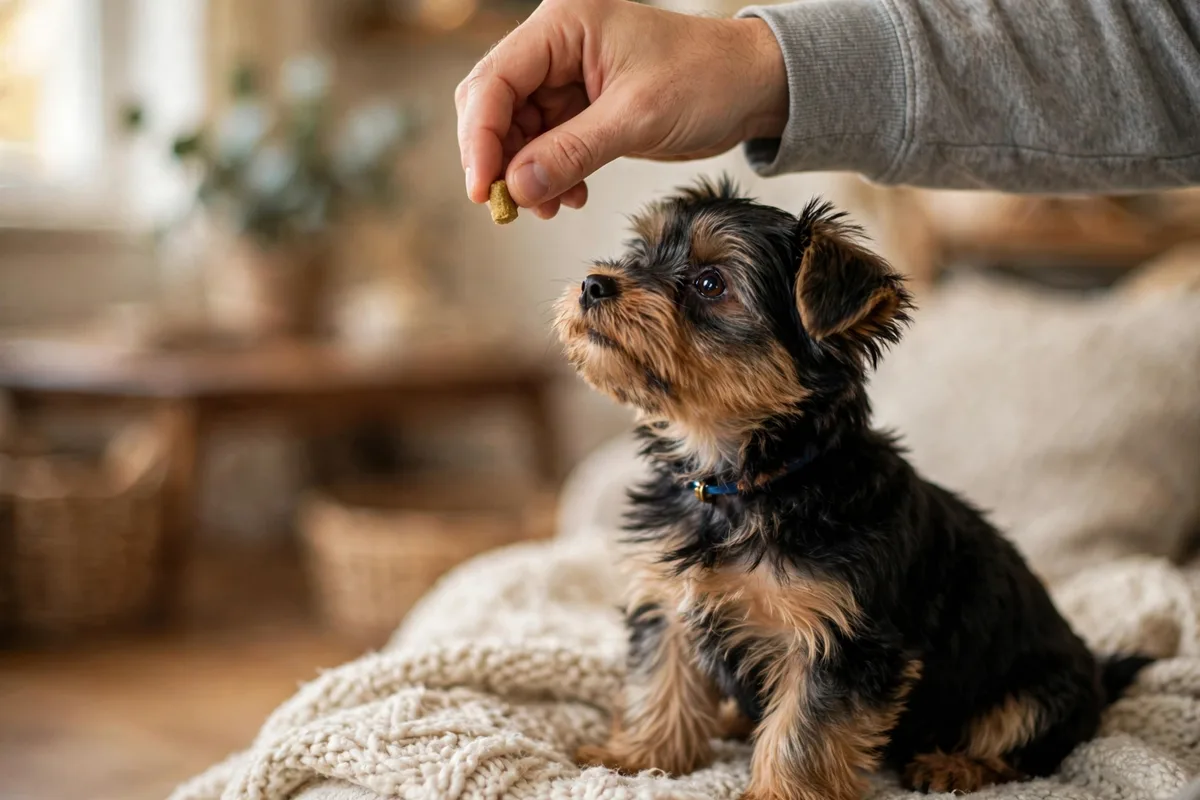
Puppies (8 weeks to 6 months) learn fast but tire faster. Keep sessions to two or three minutes, use extra-small treats, and train after a nap. Don’t skip the fade-the-lure step even if your puppy picks things up fast. Our new puppy checklist covers the other basics to set up alongside training.
Adult dogs can handle five-minute sessions two or three times a day. Expect the same timeline as a puppy — possibly faster, since adults have longer attention spans. The biggest hurdle is usually the owner’s habits: saying the word too early and repeating it too often.
Senior dogs can absolutely learn, and training is great mental exercise. Keep sessions short, train on a non-slip surface (slick floors make sitting uncomfortable for arthritic hips), and use soft, easy-to-chew treats. Reward a partial sit or even a weight shift backward — the goal is a comfortable, offered position, not a textbook pose. Check with your vet if sitting seems painful rather than just unfamiliar.
Troubleshooting Common Sticking Points
| Problem | Fix |
|---|---|
| Dog jumps instead of sitting | Lower the lure and move it more slowly, keeping it close to the nose |
| Dog backs up | Train with the dog’s rear near a wall, or lure more upward than backward |
| Dog sits, then pops right up | Add a release word and reward short holds before releasing |
| Dog only sits when it sees a treat | Go back to Step 4: empty hand, treat delivered from the other hand |
| Dog sits at home but not outside | Too much distraction, too soon — new location means fresh reps with the lure |
| Dog looks confused, offers random behaviors | Sessions are too long or criteria jumped too fast — end the session and go back one step next time |
If a session goes badly, end it. Training through frustration teaches both of you that training is frustrating. A fresh session tomorrow fixes more than a forced extra ten minutes tonight.
Frequently Asked Questions
How long does it take to teach a dog to sit?
Most dogs learn the movement in the first session and respond to the word reliably within one to two weeks of short daily sessions. Proofing it — making it work outside, around people, and around other dogs — takes several more weeks of practice in gradually harder settings.
Can I train my dog to sit without treats?
Eventually, yes. Once the behavior is reliable, reward intermittently — every other sit, then every third — and mix in praise, petting, and real-life rewards like the door opening. But build the behavior with treats first; they’re the clearest paycheck while your dog is learning.
My dog knows “sit” but ignores me at the park. What gives?
Your dog knows the cue in your kitchen. Every new environment is a new classroom: go back to the lure for a few reps in each new location, then fade it again. Most dogs need practice in a dozen or so locations before a cue is solid everywhere.
Is it too late to teach an old dog to sit?
No. Senior dogs learn cues at any age; just keep sessions short, surfaces grippy, and expectations adjusted for stiff joints.
Sit Today, Good Manners Tomorrow
Sit is a small behavior with an outsized payoff. It gives your dog a polite way to say please, it gives you a tool for every doorway and curb, and it gives both of you the first shared vocabulary of training. Run a few five-minute sessions this week, fade the lure early, and say the word once. Next, build on it with basic leash manners, where that same calm control follows you out the front door.