
Indoor cats live safer lives than outdoor ones — no traffic, no predators, no disease exposure from strays. But safety comes with a trade-off: the average living room is a desert of stimulation compared to the outdoor world a cat’s instincts were built for. A bored indoor cat doesn’t just nap more; boredom shows up as overeating, nighttime zoomies, scratching your furniture, and picking fights with housemates. Enrichment is how you bring the interesting parts of the outdoors inside, and most of it costs little or nothing.
What “Enrichment” Actually Means
Enrichment isn’t a shopping list of cat toys. It’s anything that lets your cat use their natural behaviors: hunting, climbing, scratching, exploring, watching, and problem-solving. A good indoor environment gives a cat five things:
- Vertical space — height is confidence for a cat.
- Hunting play — stalking, chasing, and catching.
- Novelty — new sights, smells, and textures on a regular basis.
- Foraging — working for food instead of eating from a bowl.
- Choice — the ability to move between sun, shade, company, and solitude.
When these are in place, most “behavior problems” fade on their own — because they were boredom problems all along. For more on the scratching side of enrichment, our guide to choosing a scratching post for a cat walks through matching a post to your cat’s style.
Step 1: Think in Three Dimensions
Cats experience a home vertically. A small apartment with height feels bigger to a cat than a large house that’s all flat floor.
- Clear the high ground. The tops of bookshelves, wardrobes, and the refrigerator are prime real estate. Remove fragile items and give your cat the runway.
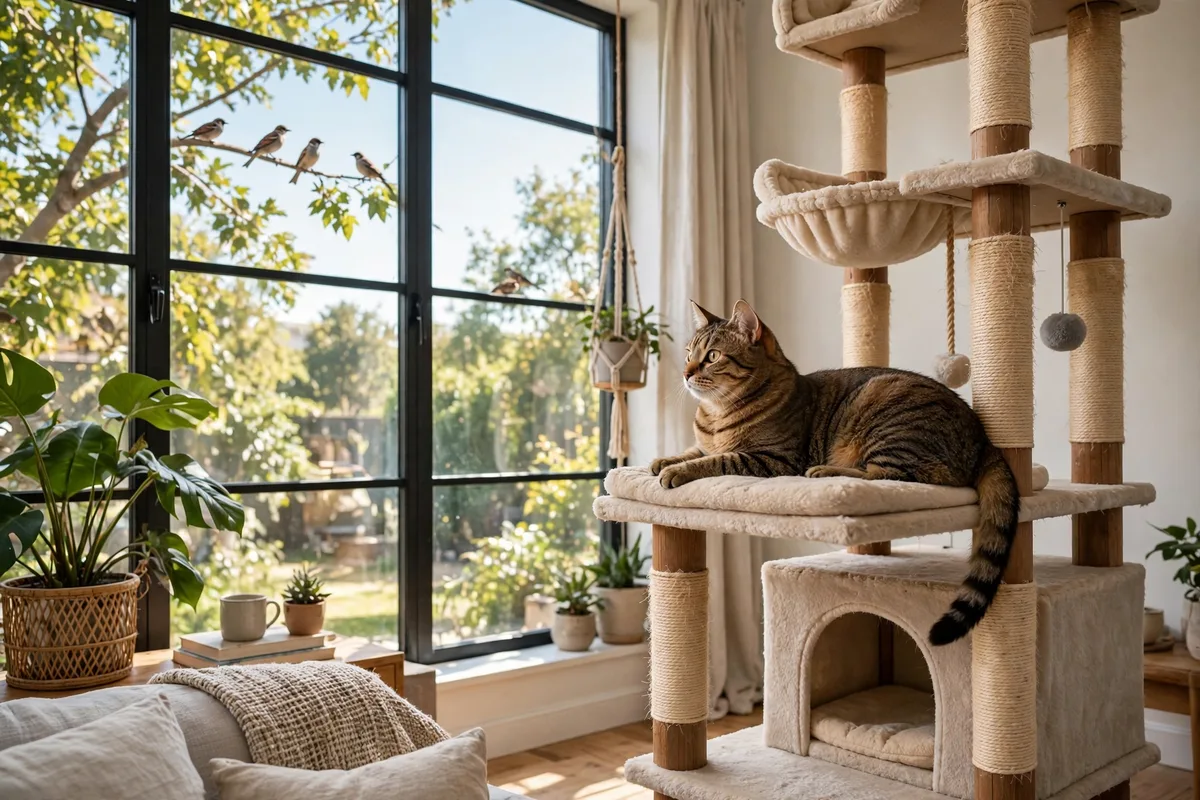
- Add a cat tree with at least one platform above your eye level, positioned near a window if possible.
- Install floating shelves as a climbing route — stagger them about 12 to 18 inches apart so jumps are easy, and anchor them into studs.
- Set up a window perch. A sturdy suction-cup or sill-mounted perch gives your cat a front-row seat to birds, squirrels, and street life — hours of free entertainment.
Make sure every high spot has a safe way down, not just up. Older or heavier cats appreciate a ramp or a stepped route rather than one big leap.
Step 2: Build a Daily Hunting Ritual
Play isn’t optional exercise — it’s how cats discharge the predatory sequence wired into them: stalk, chase, pounce, catch. An unplayed-with cat will rehearse that sequence on your ankles at 3 a.m.
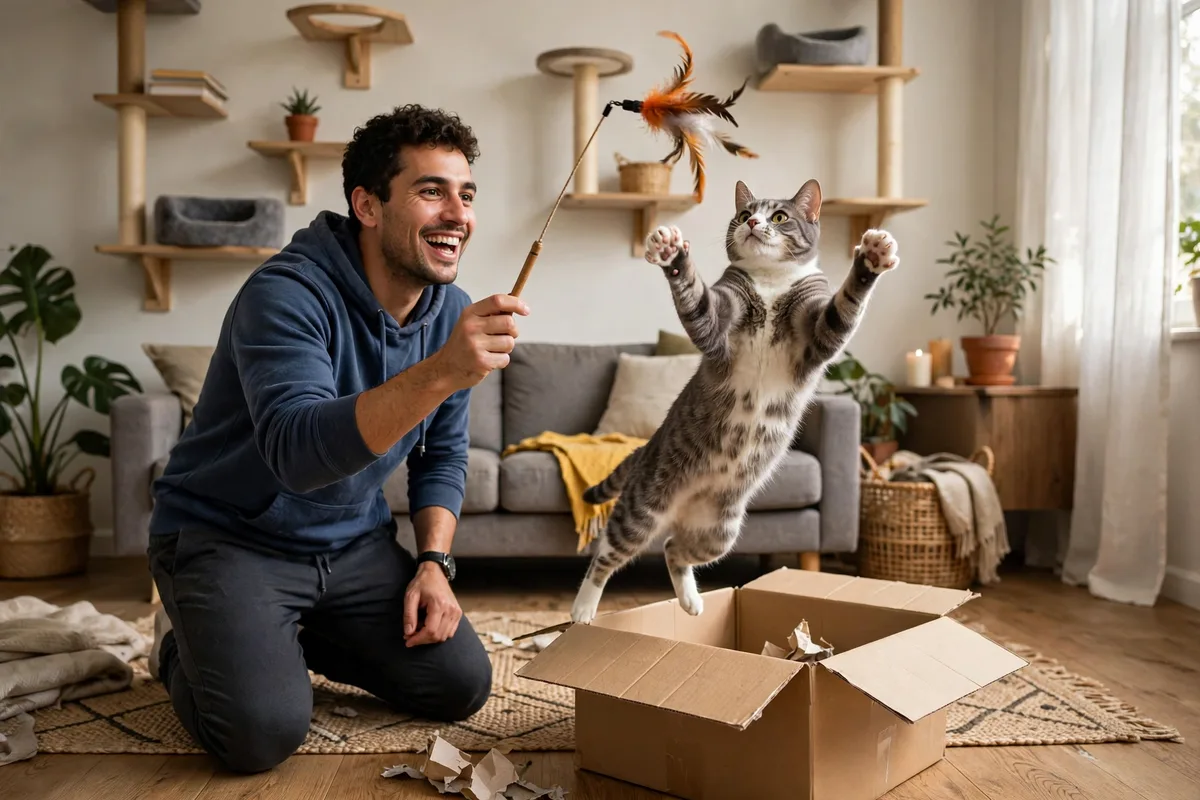
- Use a wand toy with a feather or fuzzy lure. Drag it along the floor, dart it behind furniture, let it “hide” — mimic prey behavior, not random flailing.
- Let your cat catch it. End each play burst by letting the cat “kill” the toy, then offer a small treat or meal. This completes the hunt-eat-groom-sleep cycle and genuinely settles cats down.
- Play twice a day for 10 to 15 minutes. A morning session and an evening session (timed before bed) make the biggest difference for nighttime restlessness.
- Put interactive toys away after playtime. Wand toys with strings and small detachable parts aren’t safe for unsupervised chewing — store them in a drawer.
Rotate a small set of solo toys weekly — keep five or six out and stash the rest. An old toy returning after two weeks feels new again. Cardboard boxes and paper bags (handles cut off) are free enrichment that most cats prefer to expensive gadgets.
Step 3: Turn Meals Into Foraging
In the wild, cats spend a large part of their day hunting. Eating every meal from a bowl in thirty seconds wastes that instinct entirely.
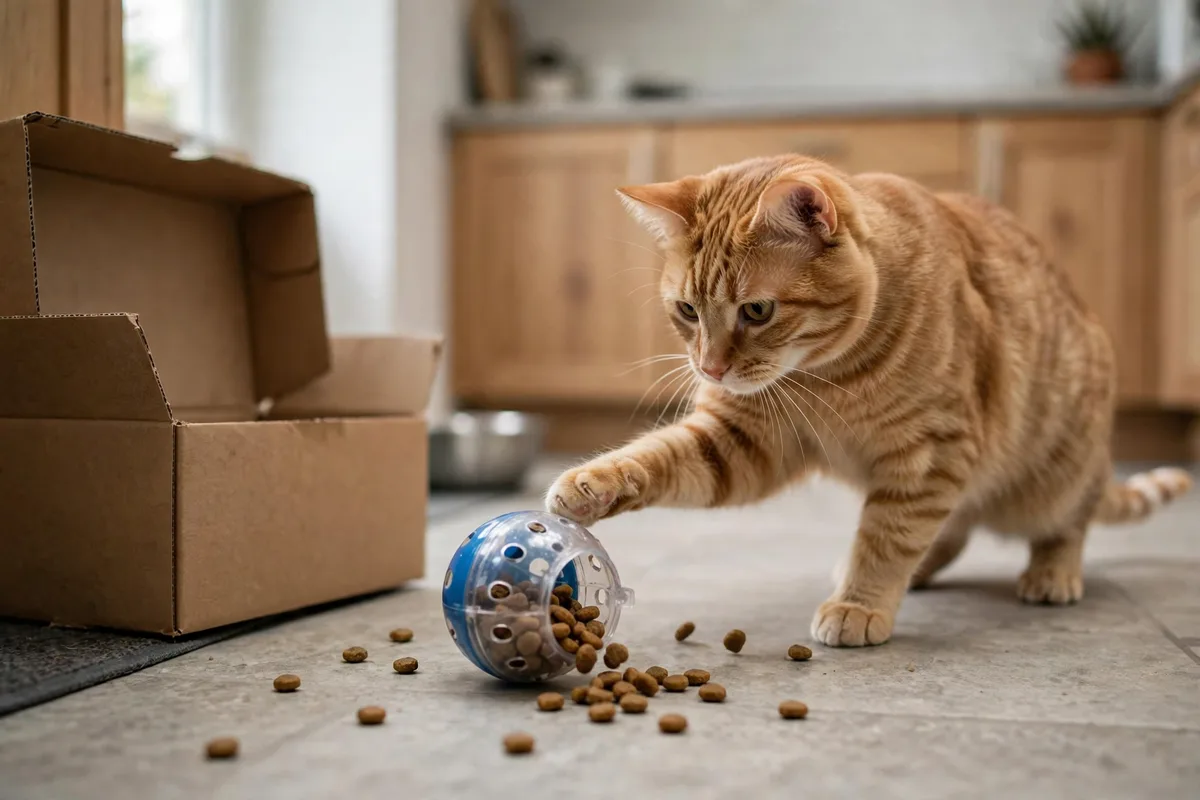
- Start simple: scatter a portion of dry kibble across a clean floor or hide pieces in a muffin tin so your cat has to work for each bite.
- Add a puzzle feeder. Start with an easy one — a ball with a hole, a snuffle-style mat — and increase difficulty only when your cat solves it confidently. A feeder that’s too hard causes frustration, not fun.
- Hide treats around the house in easy spots at first: behind a chair leg, on a low shelf. Make the hiding spots trickier as your cat gets the game.
- Try a lick mat with a thin smear of wet food for slow, calming eating.
If you have multiple cats, feed them in separate spots so no one guards the puzzles. And keep the overall routine predictable — a written pet feeding schedule helps every cat in the house know what to expect.
Step 4: Feed the Senses
Cats live through their noses and ears as much as their eyes.
- Scent rotation. Once a week, introduce a novel safe scent: a rinsed leaf or pine cone from outside, a paper bag from a new store, a pinch of dried catnip or silvervine on a scratcher. Remove anything your cat ignores and rotate.
- Cat grass. A small pot of oat or wheat grass gives your cat something to chew and interact with — and keeps their attention off your houseplants.
- Safe sounds. Low-volume nature sounds or soft music can add background interest. Keep it quiet — cat hearing is far more sensitive than ours.
- Texture variety. A sisal mat in one corner, a fleece blanket in another, a cardboard scratcher by the window. Cats sample surfaces the way we sample food.
Skip essential-oil diffusers as scent enrichment — many essential oils are unsafe for cats. Stick to plant and food-based novelties.
Step 5: Create Hiding and Resting Choices
An enriched cat needs downtime options too. Provide several resting spots at different heights and temperatures: a sunny window spot, a cozy cave or covered bed, a cool tile floor option in summer. A cat that can choose where to rest is a calmer cat. In multi-cat homes, each cat needs their own preferred spots — competition over a single sunny perch is a daily stressor that enrichment should reduce, not create.
Step 6: Add Social Enrichment on the Cat’s Terms
Some cats want company; some want a quiet house. Match the social input to your cat:
- Daily one-on-one time — grooming, gentle play, or just sitting together. Even independent cats benefit from predictable contact.
- Training. Yes, cats can learn. Target training with a stick and treats teaches your cat to touch a target, come when called, or go to a mat. Five-minute sessions are mentally exhausting in the best way.
- A compatible companion is the biggest enrichment upgrade for a social cat left alone all day — but “compatible” is doing heavy lifting in that sentence. If you’re considering a second cat, read how to introduce a new cat to a home first; a rushed introduction undoes all the benefits.
Troubleshooting Enrichment Problems
| Problem | Try this |
|---|---|
| Cat ignores all toys | Try different prey types — some cats want feathers, others want crinkly or furry lures; try playing at dawn and dusk when hunting instinct peaks |
| Cat solves puzzle feeders instantly | Level up the difficulty; use them for full meals, not just treats |
| Cat scratches furniture despite a post | The post may be wrong — wrong material, too short, or poorly placed (see troubleshooting there) |
| Zoomies at 3 a.m. every night | Add an evening play-then-feed session; make daytime more active with foraging and window time |
| Cat overeats from boredom | Shift calories into puzzle feeders and foraging; add two short play sessions daily |
| One cat bullies the other | Add duplicate resources — second tree, second perch, separate feeding stations — so there’s nothing worth guarding |
Frequently Asked Questions
My cat just sleeps all day. Is that boredom or normal?
Adult cats sleep 12 to 16 hours a day, so lots of napping is normal. The difference is what happens when they’re awake: an enriched cat wakes up, plays, explores, and interacts. A bored cat wakes up, eats, and goes back to sleep — or invents trouble. Watch the waking hours, not the sleeping ones.
How much does enrichment cost?
The essentials can be nearly free: cardboard boxes, paper bags, a homemade wand toy, scattered kibble, a cleared bookshelf top. The one purchase worth making is a sturdy cat tree, and even a basic one transforms a home. Enrichment is mostly about routine and creativity, not spending.
Is a screened balcony or “catio” worth it?
For many indoor cats, a secure enclosed outdoor space is the single best enrichment upgrade — fresh air, sun, real sounds, and visual stimulation with none of the roaming risks. Even a simple window box with secure screening counts. Just make sure every panel is escape-proof before the first outing.
Should I leave the TV on for my cat?
Bird and fish videos can entertain some cats for a while, but they’re a supplement, not a substitute — they don’t satisfy the stalk-and-catch sequence the way interactive play does. Use them as background novelty, and secure the screen so an enthusiastic paw doesn’t topple it.
A Boring House Is a Fixable Problem
You don’t need a bigger home or an expensive toy collection. Clear a shelf, start a ten-minute evening play ritual, scatter tonight’s kibble instead of bowling it, and put a box on the floor. Small changes compound: within a couple of weeks, most owners see a calmer, leaner, more playful cat. Enrichment isn’t a project you finish — it’s a rhythm you keep, one novel smell and one good play session at a time.